On My Shelf: January-March

Here’s a behind-the-scenes look at what I’ve been reading over the past few months. I’ve included a brief description of each book from Amazon to give you a taste of what they’re about. Perhaps one of these titles will catch your interest and motivate you to add it to your cart! Before you start scrolling, let me mention some things about these books:

  • I don’t agree with every point in every book I read.
  • I’ve found all of these books to be very helpful.
  • I’ve found some of these books to be more helpful than others.
  • I’ve listed these books in the order that I read them.

Ted Talks: The Official TED Guide to Public Speaking by Ted Anderson
“Done right, a talk can electrify a room and transform an audience’s worldview; it can be more powerful than anything in written form. This “invaluable guide” (Publishers Weekly) explains how the miracle of powerful public speaking is achieved, and equips you to give it your best shot. There is no set formula, but there are tools that can empower any speaker. 

Since taking over TED in 2001, Chris Anderson has worked with all the TED speakers who have inspired us the most, and here he shares insights from such favorites as Sir Ken Robinson, Salman Khan, Monica Lewinsky, and more— everything from how to craft your talk’s content to how you can be most effective on stage.”

The Pastor as Leader: Principles and Practices for Connecting Preaching and Leadership by John Currie
“Many pastors feel torn between preaching and leading, but both responsibilities are essential. Without faithful exposition of Scripture, churches risk straying theologically. Without strong leadership, teaching lacks spiritual zeal. How can pastors find balance and steward their calling effectively?

In The Pastor as Leader, John Currie equips pastors to be men of God who competently carry out their purpose: leading God’s people through the preaching of God’s word. Recognizing a common disconnect between the roles of preaching and leadership, Currie offers foundational principles for pastoring “under Christ’s appointment, conformed to Christ’s character, which exemplifies and implements Christ’s wisdom, preached from Christ’s word.” By integrating two primary roles of the pastorate, readers will learn how to faithfully and confidently proclaim the Scriptures as they communicate biblical vision and strategy for the church’s mission.”

“Pastoral leadership is the process where, for the glory of God, a man of God, appointed by the Son of God and empowered by the Spirit of God, proclaims the Word of God so that the people of God are equipped to move forward into the purposes of God together.” John Currie

Whatever Happened to The Gospel of Grace?: Rediscovering the Doctrines that Shook the World by James Montgomery Boice

“We don’t like to admit it, but anyone who honestly evaluates the church’s life and outlook will understand that these are not good days for evangelicalism. We’ve achieved success, but in a worldly sort of way–big numbers, big budgets, and big outreaches. Yet church attendance is actually down and alleged “born again” believers do not differ significantly in their worldview from their neighbors. Why? We have forgotten our theology and, consciously or not, have pursued the wisdom of the world, accepted its “doctrines,” and utilized its methods.

Pastor James Montgomery Boice believed that our ignorance of God and neglect of the gospel of grace is the root of the problem. Here he identifies what’s happening within the church and explains how the five doctrinal truths that transformed the world during the Reformation not only offer the solution but can shape a renewal today.

By offering people what they desperately lack–the Word of God and salvation through Christ–rather than giving them an imitation of what they already have, we will see Christianity thrive once again. And in holding fervently to the foundational truths of the gospel, we will know the power of spiritual renewal in our churches.”

How to Read a Book: Advice for Christian Readers by Andrew Naselli

Imagine a well-read man. Do you see a machine dressed in tweed gorging on information? This book is not about becoming that kind of reader.

The well-read man wakes up and consults with Moses on the way to work. He sips his coffee and ponders the wisdom of Hannibal’s elephants crossing the Alps. He turns furrowed-browed philosophers upside down and takes their lunch money. He changes his oil and deliberates with Peter Drucker about effective management practices. He regales his wife with the tale of Monet’s water lilies in the Gardens at Giverny. He sings with Sandra Boynton as his toddlers’ eyes grow heavy. This book is about becoming that man. Be as human as you can be. Learn how to read a book.

The Chronicles of Narnia (7 Book Box Set) by C.S. Lewis

“The hardcover box set of C. S. Lewis’s classic fantasy series The Chronicles of Narnia, with cover art by three-time Caldecott Medal-winning illustrator David Wiesner and the full black-and-white original interior art by Pauline Baynes.

Journeys into magical realms, battles between good and evil, talking creatures, and more, await readers of all ages in The Chronicles of Narnia.

This timeless box set includes all seven titles—The Magician’s NephewThe Lion, the Witch and the Wardrobe; The Horse and His BoyPrince CaspianThe Voyage of the Dawn TreaderThe Silver Chair; and The Last Battle—with interior black-and-white art by Pauline Baynes, the original illustrator.”

“Some day you will be old enough to start reading fairy tales again.” C.S. Lewis

Predestination: An Introduction (Short Studies in Systematic Theology) by Andrew Naselli

A Concise and Systematic Exploration of the Doctrine of Predestination. . . . 

How can God choose to save some and eternally punish others? What about my loved ones who are not believers? For many, contemplating predestination brings about fear, trepidation, controversy, and emotional exhaustion, making it a difficult topic to study―let alone view as a blessing. 

This addition to the Short Studies in Systematic Theology series carefully examines God’s word to answer 15 commonly asked questions regarding the doctrines of election and reprobation. With helpful visuals, key definitions, answer summaries, and prayer responses, this concise guide is perfect for all believers who want to discover and delight in what God has revealed throughout Scripture. Readers will not only learn how God saves his people from their sins, but will be stirred to respond to him in worship.”

40 Questions About Calvinism by Shawn Wright

“In 40 Questions About Calvinism, church historian Shawn Wright tackles many issues about the theological system known as Calvinism. Taking an irenic approach, Wright explains the key doctrines while also contrasting them with Arminianism. The accessible format allows readers to easily look up topics they’re most interested in, including:

  • What is the difference between Calvinism and the Reformed tradition?
  • Does God love all people?
  • What is predestination?
  • Did Jesus die for the sins of the whole world?
  • Can people resist the Holy Spirit?
  • Do Calvinists practice evangelism and missions?

For Calvinists or those seeking to understand Calvinism better, 40 Questions About Calvinism helps readers understand the key terms, issues, and debates of this highly influential theological viewpoint.”

40 Questions About Arminianism by Matthew Pinson

“The actual life and teaching of Jacobus Arminius are often unknown or misunderstood. Answers beyond a basic caricature can be elusive. In 40 Questions About Arminianism, however, J. Matthew Pinson combines solid historical research with biblical and doctrinal precision to address the following questions and more: 

  • Who was Jacobus Arminius?
  • How has the church interpreted God’s desire that everyone be saved?
  • How is Arminianism different from Calvinism?
  • Can one be both Reformed and Arminian?
  • What is “universal enabling grace”?
  • What do Arminians mean by “free will”?
  • Do Arminians believe that God predestines individuals to salvation?
  • Is it possible for a Christian to apostatize?

An accessible question-and-answer format helps readers pursue the issues that interest them most, with additional resources available at 40questions.net. Questins regarding historical backgrounds and the Bible encourage a broad understanding of historic and contemporary Arminianism.”


In January, I began a Sunday evening teaching series on the Ten Commandments titled “An Introduction to Christian Ethics.” Here’s a look at the resources I’ve used.

And God spoke all these words, saying, ‘I am the Lord your God, who brought you out of the land of Egypt, out of the house of slavery.” Exodus 20:1-2

An Introduction to Biblical Ethics by David Jones

“This book serves as an introduction to the field of biblical ethics, a subcategory of the discipline of moral theology. It differs from moral philosophy in that biblical ethics is distinctively Christian, and it is more specific than Christian ethics proper because it specifically focuses upon the application of the moral law — as it is revealed in Scripture — to daily living. 

Introduction to Biblical Ethics explains the nature, relevancy, coherency, and structure of the moral law as revealed throughout the Bible. In addition to covering the foundational elements of biblical ethics, major issues investigated in this volume include: different types of law in Scripture, the relationship between the law and the gospel, and issues related to the prospect of conflicting moral absolutes. 

Additionally, after a discussion of ethical methodology, and using the Ten Commandments as a moral rubric, author David W. Jones explores the place of the moral law in the lives of believers. In the final chapters, the events surrounding the giving of the Decalogue are surveyed, and the application of each of the Ten Commandments to Christian living is explored.”

Written in Stone: The Ten Commandments and Today’s Moral Crisis by Philip Ryken
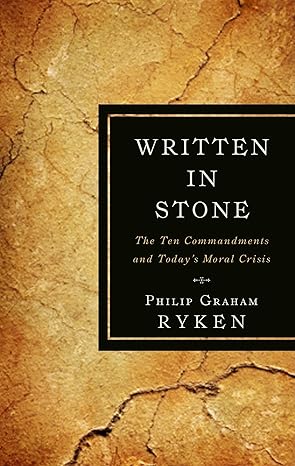
“The Ten Commandments are an expression of God’s eternal character and having binding force today. Here Philip Ryken offers basic principles for interpreting and applying them—explaining them one by one, illustrating each with a biblical account, and relating each to the preson and redemptive work of Jesus Christ.”

Philip Ryken offers basic principles for interpreting and applying the Ten Commandments―explaining each one, illustrating each with a biblical account, and relating each to the person and redemptive work of Jesus Christ.

This is a book to be read and savored. Readers will find themselves examining their own lives, changing their ways, and delighting in newfound grace.”

The Ten Commandments by Thomas Watson

“In this book Thomas Watson continues his exposition of the Shorter Catechism drawn up by the Westminster Assembly. Watson was one of the most popular preachers in London during the Puritan era. His writings are characterized by clarity, raciness and spiritual richness. The series of three volumes, of which this is the second, makes an ideal introduction to Puritan literature.

There are few matters about which the Puritans differ more from present-day Christians than in their assessment of the importance of the ten commandments. The commandments, they held, are the first thing in Christianity which the natural man needs to be taught and they should be the daily concern of the Christian to the last.

In The Ten Commandments Watson examines the moral law as a whole as well as bringing out the meaning and force of each particular commandment. In view of the important function of the law in Christian life and evangelism this is a most valuable volume.”

The Ten Commandments: What They Mean, Why They Matter, and Why We Should Obey Them by Kevin DeYoung

“Are the 10 Commandments still relevant today? Do they still apply? Which ones? What do they mean in light of God’s mercy revealed in Jesus?

Highlighting the timelessness and goodness of God’s commands, pastor Kevin DeYoung delivers critical truth about the 10 Commandments as he makes clear what they are, why we should know them, and how to apply them. This book will help you understand, obey, and delight in God’s law―commandments that expose our sinfulness and reveal the glories of God’s grace to us in Christ.”

Words From the Fire: Hearing the Voice of God in the 10 Commandments by Albert Mohler

“If God has spoken, then the highest human aspiration must be to hear what the Creator has said. God has indeed spoken, through the Ten Commandments, and Al Mohler explores this revelation of God and the implications for His people. The promise is to hear, to obey, and to live. These “Ten Words” tell us who God is and what His people should look like. 

Mohler is a respected voice on the state of our culture (and the church) today. The Ten Commandments speak to current issues today such as the exclusivity of the Christian God, the essence of worship, capital punishment, just war, business ethics and the postmodern definition of truth.”

The Doctrine of the Christian Life by John Frame

“In this book, I urge readers not to side with either tendency. The point of Christian ethics is not to be as liberal as we can be, or as conservative. It is, rather, to be as biblical as we can be. So this book will seem to be more liberal than the majority on some issues and more conservative on others. God’s Word has a way of surprising us, of not fitting into our prearranged categories.

Jesus rebuked both the conservative Pharisees and the liberal Sadduccees; Paul rebuked both legalists and libertines. Understanding God’s will rarely means falling into lockstep with some popular ideology. We need to think as part of a community, listening to our brothers and sisters, but we also need the courage to step aside from the crowd when God’s Word directs us in that way.”

“If books are among our friends, we ought to apply similar standards to them that we apply to our flesh-and-blood friends. We should want to choose them wisely and well and hope that we will be the better for their companionship.” Doug Wilson


Article Roundup: Helpful Reads

Be Faithful Over Little: A Different Vision for a Life That Counts by Chase Krug

While some Christians may be called to martyrdom, most are called to live an ordinary yet faithful Christian life, which is truly extraordinary! “I wanted to change the world. My nagging fear wasn’t that I’d commit adultery or leave the faith but that I’d live a largely forgettable, quiet, “meh” life for Christ. While eternal life by grace through faith in Jesus felt like winning, a pedestrian contribution to Christ’s kingdom felt like losing. Thankfully, God used the parable of the talents (Matt. 25:14–30) to shatter and reconstruct my understanding of good and faithful service to Christ.”

“What Do You Want Me to Do for You?””: Clarity in Prayer by Andy Davis

Andy Davis uses the story of Jesus’ interaction with Blind Bartimaeus to argue in favor of specificity in prayer. “When you come to King Jesus to pray, as you enter the throne room of grace and kneel before your gracious and generous king, picture him looking at you kindly and saying, “What do you want me to do for you?” Then be very clear what you want and speak it to him by faith. And watch what he alone can do!”

Is Your God Too Small? by Paul David Tripp

The God of Scripture is supreme, glorious, and majestic. There is none like Him. Oh, that God would grant us wisdom and knowledge to better grasp who He is, as revealed in sacred writ! “I’m persuaded that much of our fear, anxiety, discouragement, and hopelessness is the result of bad theology. At its core, what is the Bible all about? The existence, character, and plan of God. Every other aspect of Scripture flows out of the reality of who God is. A bad or weak theology of God will lead to weakness in other areas of theology, and spiritual weaknesses in daily living.”

A Heart for Adoption by Dan Cruver

May the Lord use Dan Cruver’s exploration of the Father’s adoption of rebellious sinners to kindle our passion for caring for orphans. “One of the gifts that a heart aflame with the adoptive love of our triune God has is an increasing openness to those who are fatherless in this sin-cursed, sin-spoiled world. Because of the rebellion of our first parents, Adam and Eve, we find ourselves in a world that idolizes the strong and powerful, but marginalizes the weak and powerless. Because of what God has done for us through adoption, our Father eventually and inevitably awakens in us a heart for orphaned children.”

Is Your Christianity Too Quiet by Greg Morse

Since we often limit our Christian faith to church buildings and homes, Greg Morse writes a challenging and convicting article that will not leave you unscathed. “Though the heavens cannot contain him, though earth is his footstool, do we — his grasshoppers leaping upon his lawn — try to cage the living God in church buildings and around dinner tables?”

On My Shelf: April-September

Here’s a behind-the-scenes glance at the books I’ve read since April. (I usually post an On My Shelf blog every three months, but I’ve been slacking.) I’ve added a brief book description from Amazon to give you a taste of each book. Perhaps one of these books will garner your attention and compel you to add it to your cart! But let me mention a few things before you start scrolling:

  • I don’t agree with everything in every book I read
  • I’ve found all of these books helpful
  • I’ve found some of these books more helpful than others
  • These books are listed in the order I read them

Pastor, Jesus Is Enough: Hope for the Weary, the Burned Out, and the Broken by Jeremy Writebol

In Pastor, Jesus Is Enough, Jeremy Writebol invites pastors to hear the words of the risen Jesus in the seven letters within Revelation 2–3:

  • Pastors love Jesus most
  • Pastors suffer
  • Pastors teach and tell the truth
  • Pastors become like Jesus
  • Pastors abide in Jesus
  • Pastors find their value in Jesus
  • Pastors repent

The exhortations in Revelation 2–3 are directed to churches. But they also exhort pastors. In these letters, Jesus draws near to pastors―whether hurting or straying―and reminds them of his sufficiency. In these warnings and promises, Jesus has hard words for pastors. But they are words of life. Most of all, Jesus urges pastors to keep their focus on him. Being enough is exhausting. But pastor, the good news is that you cannot be enough. Because only Jesus is enough.

The Compelling Community: Where God’s Power Makes a Church Attractive by Mark Dever & Jamie Dunlop

What does a community that testifies to God’s power look like? God’s people are called to a togetherness and commitment that transcends all natural boundaries―whether ethnic, generational, or economic. But such a community can be enjoyed only when it relies on the power of God in the gospel.

In The Compelling Community, pastors Mark Dever and Jamie Dunlop cast a captivating vision for authentic fellowship in the local church that goes beyond small groups. Full of biblical principles and practical advice, this book will help pastors lead their congregations toward the kind of community that glorifies God, edifies his people, and attracts the lost.

America’s Religious History: Faith, Politics, and the Shaping of a Nation by Thomas Kidd

America’s Religious History is an up-to-date, narrative-based introduction to the unique role of faith in American history. Moving beyond present-day polemics to understand the challenges and nuances of our religious past, leading historian Thomas S. Kidd interweaves religious history and key events from the larger story of American history, including:

  • The Great Awakening
  • The American Revolution
  • Slavery and the Civil War
  • Civil rights and church-state controversy
  • Immigration, religious diversity, and the culture wars

Useful for both classroom and personal study, America’s Religious History provides a balanced, authoritative assessment of how faith has shaped American life and politics.

Caring for One Another: 8 Ways to Cultivate Meaningful Relationships by Edward Welch

Imagine . . . an interconnected group of people who entrust themselves to each other. You can speak of your pain, and someone responds with compassion and prayer. You can speak of your joys, and someone rejoices with you. You can ask for help with sinful struggles, and someone prays with you.

The goal of this book is that these meaningful relationships will become a natural part of daily life in your church. With short chapters and discussion questions meant to be read in a group setting, Ed Welch guides small groups through eight lessons that show what it looks like when ordinary, needy people care for other ordinary, needy people in everyday life.

Are We Living in the Last Days?: Four Views of the Hope We Share about Revelation and Christ’s Return by Bryan Chapell

Will Jesus’s return be preceded by a single world government? Will every person have a government-issued ID or mark? Does Christ return once or twice? Will believers go through a Great Tribulation? Will there be a literal battle of Armageddon? Does it even matter what we believe about future events?
Biblical prophecies about the end times have confused, confounded, and even divided God’s people for centuries. But the reason Scripture gives us hints about the future is to provide the encouragement we need to endure the present, confident that God keeps his promises.

In this balanced look at four major views of the end times, bestselling author Bryan Chapell explains the primary ways Christians have interpreted biblical prophecy about the last days, not so that we might pick a hill to die on but so that we can cling to what unites us in Christ. No matter what end times view we find most compelling, in God’s plans we can find strength for today and hope for tomorrow.

Decisions Made Simple: A Quick Guide to Guidance by Tim Chester

How we get reliable guidance is always a hot topic for Christians. Should we wait for a personal ‘word’ from the Lord, perhaps delivered by some mysterious process? Does God have anything to say about the daily matters that concern his people? Can the Bible be involved in our understanding the will of God for our lives, considering that it was written when so much that is familiar to us was not dreamt of? Perhaps most importantly of all, the dangers of personal decision and guidance without considering our relationship with others, particularly the believing community, are raised. Tim Chester addresses the issues and provides clear, thoughtful biblical answers. Reflections on each section and a final decision-making checklist make this a truly practical and readable guide.

Understanding Baptism (Church Basics) by Bobby Jamison

What’s the big deal about baptism? Jesus commands his disciples to be baptized, and it’s a glorious picture of a person’s union with Jesus’ death, burial, and resurrection. Still, many Christians feel unclear about the topic, having more questions than answers. This short work provides a biblical explanation of baptism. What is it? Who should be baptized? Why is it required for church membership? And how should churches practice baptism?

Spiritual-Mindedness (Puritan Paperbacks) by John Owen

Thomas Chalmers wrote that Owen’s book on Spiritual-Mindedness holds ‘a distinguished rank among the voluminous writings of this celebrated author’. For him three features made it very special: -The force with which it applies truth to the conscience. -The way Owen plumbs the depths of Christian experience as a skillful physician of the soul. -The uncovering of the secrets of the mind and heart so that the true spiritual state of the reader is discovered. This book began life as a collection of meditations on Romans 8:6, which were written for the author’s own benefit during a time of illness. Alarmed by the subtle power the world exercises over the mind, Owen shows us how to really live by raising our thoughts above all earthly objects and setting them on ‘things above, where Christ is’ (Col. 3:1) A favorite book of William Wilberforce, it contains some passages which are not surpassed in all of Owen’s writings. It comes from the pen of a tender-hearted pastor whose only purpose is to encourage the believer in the ongoing battle against sin. So if you feel overwhelmed by the power of worldliness then this is definitely the book for you!

Undistracted: Capture Your Purpose. Rediscover Your Joy by Bob Goff

The world has never been more distracting—joy has never been more possible.

You live with a massive amount of distraction:

  • desperate headlines
  • smartphone scrolling
  • an endless to-do list

Not to mention the nagging questions of your heart:

  • Am I making the right decision? 
  • Am I with the right person? 
  • Will my past mistakes keep me from my best future?

Through the pithy and inspiring storytelling that has endeared him to millions, New York Times bestselling author Bob Goff invites you to laugh with more gusto, dream with more confidence, and love with more intention in this disarming call to live Undistracted. Bob’s stories are like the rumble strips on the road that make you suddenly alert to how far you have drifted from your lane. From visiting friends in San Quentin to accidentally getting into a stalker’s car at the airport to establishing Uganda’s first space program, Bob shows you the way back to an audaciously attentive life. Your undistracted life is an adventure waiting to happen. What stories will you live with undistracted purpose and unstoppable joy?

When Helping Hurts: How to Alleviate Poverty Without Hurting the Poor . . . and Yourself by Steve Corbett

Poverty is much more than simply a lack of material resources, and it takes much more than donations and handouts to solve it. When Helping Hurts shows how some alleviation efforts, failing to consider the complexities of poverty, have actually (and unintentionally) done more harm than good. 

But it looks ahead. It encourages us to see the dignity in everyone, to empower the materially poor, and to know that we are all uniquely needy—and that God in the gospel is reconciling all things to himself. 

Focusing on both North American and Majority World contexts, When Helping Hurts provides proven strategies for effective poverty alleviation, catalyzing the idea that sustainable change comes not from the outside in, but from the inside out.

Chosen by God by R.C. Sproul

Chosen by God by Dr. R. C. Sproul is a contemporary classic on predestination, a doctrine that isn’t just for Calvinists. It is a doctrine for all biblical Christians. In this updated and expanded edition of Chosen by God, Sproul shows that the doctrine of predestination doesn’t create a whimsical or spiteful picture of God, but rather paints a portrait of a loving God who provides redemption for radically corrupt humans.

We choose God because he has opened our eyes to see his beauty; we love him because he first loved us. There is mystery in God’s ways, but not contradiction.

Character Matters: Shepherding in the Fruit of the Spirit by Aaron Menikoff

Pastor, it’s time to turn down the noise and focus on what matters.

Today’s pastoral world is packed with books, conferences, and seminars teaching you different techniques for being an all-star pastor, growing your church quickly, and changing the world. But the key to true success is much harder and much simpler. Pastors are called to be faithful, to have exemplary character, and to love Jesus. Without faithfulness, their ministry ends up harming others rather than helping them. Churches need pastors with sound doctrine and a sound life.

Character Matters was written to help you slow down, cut through the noise and distractions, and focus on what matters—the fruit of the Spirit. Each chapter is a guided, biblical meditation on one aspect of each piece of the fruit of the Spirit. As you reflect and focus on the simple things that matter, you’ll see your heart change and your ministry follow, slowly, surely, and by the power of the Spirit.

Spurgeon: A Life by Alex DiPrima

“In this book, Alex DiPrima has produced what many others have failed to deliver: a one-volume biography of Spurgeon that tells the story with power, insight, and due recognition of his historical significance.”

—R. Albert Mohler Jr., president, The Southern Baptist Theological Seminary

Alex DiPrima paints a fresh portrait of Charles Haddon Spurgeon, the most well-known gospel minister of the nineteenth century. By providing social, historical, and religious context, DiPrima helps us comprehend the scope of Spurgeon’s ministry in London. Combining academic expertise with popular presentation, this short biography of the famed Prince of Preachers will be the go-to introduction to Spurgeon for years to come.

The Soul-Winning Church: Six Keys to Fostering a Genuine Evangelistic Culture by J.A. Medders

How to build a culture of truly effective gospel-sharing in your church. 

Your church’s sermons often include a call to evangelize. You’ve held evangelism training events. You give out invites to your Christmas and Easter services. So… where are all the new Christians? Is your church actually reaching the lost with the gospel?

For many of us, despite having the best intentions our churches struggle to reach out with the gospel effectively. J.A. Medders and Doug Logan Jr. have decades of experience in leading churches and mentoring pastors, and here they outline six principles for cultivating a genuine evangelistic culture throughout your church. 

Includes case studies from a variety of different cultures and contexts to give you practical ideas for implementing these six principles.

Shepherds for Sale: How Evangelical Leaders Traded the Truth for a Leftist Agenda by Megan Bashan

How deeply have leftist billionaires infiltrated America’s churches?

In Shepherds for Sale, Megan Basham of the Daily Wire documents how progressive powerbrokers —from George Soros, to the founder of eBay, to former members of the Obama administration— set out to change the American church. Their goal: to co-opt evangelicals for political purposes. She exposes:

The left-wing billionaires, foundations, and think tanks that deliberately target Christian media, universities, megachurches, nonprofits, and even entire denominations

  • The left-wing billionaires, foundations, and think tanks that deliberately target Christian media, universities, megachurches, nonprofits, and even entire denominations
  • The celebrity megachurch pastor who secretly encouraged a group of pastors to change their views on sexuality
  • The revered Presbyterian theologian who backed a congregation rebelling against his own denomination

These are just a glimpse into the compromises and astroturf campaigns Basham uncovers. Many evangelical leaders are pushing their members to “whisper” about sexual sins, reconsider the importance of abortion, lament the effects of climate change, and repent of “perpetuating systemic racism.” And in exchange for toeing a left-wing line, many of those church leaders and institutions have received cash, career jumps, prestige, and praise. Basham brings the receipts, and names names.

A rigorously reported exposé, Shepherds for Sale is a warning of what happens when the church trusts the world’s wisdom instead of Scripture.


Commentaries on the Sermon on the Mount

Back in August, I began a sermon series on Matthew 5-7, The Sermon on the Mount. Here are some of the commentaries I am using:

Studies in the Sermon on the Mount by Martyn Lloyd Jones

A spiritual classic, this detailed and comprehensive study by one of the greatest expository preachers of our time explains Christ’s teaching in the Sermon on the Mount and incisively applies it to the Christian life.

With characteristic vigor and emotional vitality Dr. Lloyd-Jones presents a brilliant and detailed exposition of one of the best known but most frequently misunderstood passages of Scripture. Here is a comprehensive and exhaustive study of our Lord’s words as recorded in Matthew chapter five. This beautiful portion of the Sermon on the Mount is carefully analysed, its contents outlined and thoughtfully arranged, and vastly rich and abundant truths are gleaned for the reader’s spiritual nurture.

The author brought a wealth of devoted study as well as a profound spiritual appreciation to the work of interpreting this greatest address of our delightful experience in meditation. It presents depth of thought in simple language and beauty of style and contains a veritable thesaurus of spiritual truths drawn from the entire Bible.

Sermon On The Mount: Restoring Christ’s Message to the Modern Church by Charles Quarles

Matthew 5-7, popularly known as the Sermon on the Mount, has been described as “the essence of Christianity” and inspired many commentaries. However, New Testament professor Charles Quarles believes a fair number of those volumes either present Christ’s sermon as containing an impossible spiritual ethic or instead dilute its message so much that hardly any ethical challenge remains. Also concerning, a recent Gallup poll indicated only onethird of American adults recognize Jesus as the source of this teaching that has often inspired people who do not even embrace evangelical Christianity.

Quarles’ new analysis, part of the New American Commentary Studies in Bible & Theology series, aims to fill the gap between these extremes by dealing with the important questions of whether believers can live by the Sermon on the Mount today, and, if so, how. Looking at the Beatitudes, what it means to be salt and light, and the demand for superior righteousness, he writes to restore this crucial section of our Lord’s teaching to its proper place in His church.

The Beatitudes by Thomas Watson

The Beatitudes, written by Thomas Watson, is an exposition of Matthew 5:1-12. Thomas Watson was a prominent Nonconformist Puritan and religious author. Watson was born and raised in England and was a popular preacher until the Restoration. He is now best remembered for his many popular Christian books such as A Body of Divinity, The Godly Man’s Picture, and The Doctrine of Repentance.

The Sermon on the Mount: The Message of the Kingdom by Kent Hughes

The three chapters of Matthew known as the Sermon on the Mount contain truths so rich and powerful that even a lifetime of study could not exhaust their depths. For centuries, Jesus’s majestic portrait of the kingdom of heaven and his unparalleled instructions for godliness have captivated Christians and non-Christians alike. In this classic commentary, now revised with a fresh look and ESV Bible references, seasoned pastor R. Kent Hughes guides readers through this glorious portion of the Bible with exegetical precision, expositional clarity, and practical sensitivity. Whether used by preachers, small group leaders, or individual laypersons, this resource will prove invaluable for illuminating the Sermon on the Mount’s enduring power to enliven hearts and transform minds.

Matthew 1-7 by John MacArthur

The Old Testament looked forward to the final King of kings who would bring everlasting salvation and peace. In his Gospel, Matthew demonstrates that Jesus Christ is that King, perfect in His eternal glory and majesty. As the King’s ambassadors, Christians today will find in Matthew great motivation for heartfelt worship and service.

Join John MacArthur as he explains each verse of Matthew 1–7 in a way that is both doctrinally precise and intensely practical. Taking into account the cultural, theological, and Old Testament contexts of each passage, MacArthur tackles interpretive challenges and fairly evaluates differing views, giving the reader confidence in his conclusions. 

The MacArthur New Testament Commentary series comes from the experience, wisdom, and insight of one of the most trusted ministry leaders and Bible scholars of our day. Each volume was written to be as comprehensive and accurate as possible, dealing thoroughly with every key phrase and word in the Scripture without being unnecessarily technical. This commentary will help to give a better, fuller, richer understanding of God’s Word, while challenging the reader to a vibrant personal spiritual walk.

Sermons on the Beatitudes

I began my sermon series on the Sermon on the Mount with a mini-series on the Beatitudes. I have attached links to the audio recordings of each sermon.

Sermon on the Mount: Intro

Blessed are the Spritual Beggars

Blessed are those who Mourn

Blessed are the Meek

Blessed are those who Yearn for Righteousness

Blessed are the Merciful

Blessed are the Pure in Heart

Blessed are the Peacemakers

Blessed are the Persecuted

On My Shelf: January-March

Here’s a behind-the-scenes glance at what I’ve been reading this year. I’ve added a brief book description from Amazon to give you a taste of what each book is about. Perhaps one of these books will garner your attention and compel you to add it to your cart! But let me mention a few things before you start scrolling:

  • Just because I read a book doesn’t mean I agree with everything in it
  • I’ve found all of these books helpful
  • I’ve found some of these books more helpful than others
  • These books are listed in the order I read them

Embracing Complementarianism: Turning Biblical Convictions into Positive Church Culture by Graham Beyond and Jane Tooher

“It can be tempting to shy away from addressing the issue of gender roles in church because it’s often controversial. But this can result in churches either being increasingly influenced by secular culture or simply sticking with the status quo when it comes to what men and women do in church. 

Building on the belief that complementarianism is both biblical and positive, this book focuses on what these convictions look like in practice. Moving beyond the familiar discussions around “gender roles”, and leaving room for variety in how readers implement these ideas, it will encourage a church culture where men and women truly partner together—embracing their privileges and responsibilities, and maximizing their gifts, in joyful service of God’s kingdom.”

Pure: Why the Bible’s Plan for Sexuality Isn’t Outdated, Irrelevant, or Oppressive by Dean Inserra

“Few things bring more immediate scrutiny and impassioned angst among young adult Christians today than hearing the words “purity culture.” Serious flaws from purity culture deserve to be scrutinized, especially given its lasting negative effects on some raised in the movement. Many Christians today reject the movement—and all that it stood for—wholesale. However, we can’t ignore the clear sexual ethics of the Bible. Pure dives into the big picture of God’s design for men and women regarding sexuality, and seeks to reclaim one of the clearest teaching in the scriptures: the call to sexual purity. While purity culture gets the truth right, the approach and gospel elements it espouses are often wrong. Let’s not throw the baby out with the bath water, but rather celebrate God’s great design for marriage and the loving boundaries he has put in place for our joy, protection, and flourishing.”

Chasing Contentment: Trusting God in a Discontented Age by Erik Raymond

The biblical practice of contentment can seem like a lost art―something reserved for spiritual giants but out of reach for the rest of us. In our discontented age―characterized by impatience, overspending, grumbling, and unhappiness―it’s hard to imagine what true contentment actually looks (and feels) like. But even the apostle Paul said that he learned to be content in any and every circumstance. Paul’s remarkable contentment was something grown and developed over time.

In Chasing Contentment, Erik Raymond helps us understand what biblical contentment is―the inward gracious spirit that joyfully rests in God’s providence―and then how we learn it. Giving us practical guidance for growing in contentment in various areas of our lives, this book will encourage us to see contentment as a priority for all believers. By God’s grace, it is possible to pursue the high calling of contentment and anchor our joy in God himself rather than our changing circumstances.

Grace at Work: Redeeming the Grind and the Glory of Your Job by Bryan Chapell

“For many people, their job is merely “the daily grind” needed to provide for family or pay the bills. Yet our work is a vital means for fulfilling God’s purpose for our lives and displaying his grace to those around us. We bear God’s image in our workplaces, experiencing his blessings and expressing his nature through our efforts, integrity, creativity, generosity, and excellence. No earthly chore is without the opportunity to observe his divine hand. No challenge in task or relationship is without opportunity to represent God’s heart. 

In this book, author and pastor Bryan Chapell shares this biblical perspective of vocation, explaining how God gives purpose to our work by making it an instrument of his grace to our own hearts, as well as a way of bringing his goodness and glory into our world. Chapell explains how we can worship God by our work, rising above drudgery, duty, or self-interest with the understanding that our jobs are unique callings for displaying God’s character and care. Our work is worship when we see the glory beyond the grind, the mission in the mundane, and the grace at work.”

Authentic Ministry: Serving from the Heart by Michael Reeves

“Where does authentic ministry lie? The answer of this book is: in the heart. Authentic ministry is not simply a matter of mastering professional skills or of endlessly pouring oneself out in works of service. Rather, it springs from joyful union with Christ.

Authentic Ministry offers practical guidance and spiritual nourishment for all who serve the church. Each of the nine chapters orients readers to the “one thing [that] is necessary” (cf. Luke 10:42)—abiding in Christ—while asking and answering questions both simple and profound: What is prayer? How should I respond to suffering? Who is my friend? What is theology? What does it mean to love?”

Lloyd-Jones on the Christian Life: Doctrine and Life as Fuel and Fire by Jason Meyer

“Martyn Lloyd-Jones, commonly referred to as “the Doctor,” had a successful career in medicine before abandoning it all to become a preacher in London. His sermons―displaying the life-changing power of biblical truth―diagnosed the spiritual condition of his congregation and prescribed the gospel remedy.

This study of Lloyd-Jones’s life will encourage and exhort readers to consider the role of the knowledge of God, the power of the Spirit, and the fullness of Christ in their daily lives, allowing them to discover the inseparable union of doctrine and the Christian life.”

Perspectives on Pentecost: New Testament Teaching on the Gifts of the Holy Spirit by Richard Gaffin

“With exegetical depth, objectivity, and clarity Richard B. Gaffin examines prophecy and tongues and makes a case for the cessation of both gifts at the close of the apostolic era.

Pentecost is presented as integral to the once-for-all work of Christ and decisive for the life of the whole church. Dr. Gaffin’s biblical-theological perspective is thorough: he defines all the spiritual gifts generally; he clarifies the nature of prophecy and tongues and the question of their continuance in the church today; and he indicates how these exegetical studies bear on contemporary interest in charismatic gifts.

Perspectives on Pentacost dispels the emotionalism and confusion now surrounding the Charismatic Movement. It is a reliable study for all Bible students and an especially helpful handbook for those either associated with the Charismatic Movement or who must deal with friends or family members involved in tongues-speaking experiences.”

How to Speak a Sermon: So That People Will Listen by Larry Trotter

“A powerful sermon must have not only clearly organized biblical content but also engaging delivery. How to Speak a Sermon is about sermon delivery, particularly extemporaneous sermon delivery. Combining biblical principles with the best insights of the ages and personal experiences, it explains the power and pitfalls of extemporaneous speech, how to develop speaking ability, and why preaching method matters.”

The Titus Ten: foundations for Godly Manhood by Josh Smith

“Everything in a man’s life hinges on the kind of man he is. Yet, none of us is naturally a godly man. That’s something we have to learn, pursue, and cultivate. We need a manual to help us. This book is a manual for becoming the kind of man God intends for you to be, and leading other men to do the same. Taking ten qualities from the Apostle Paul’s short letter to his mentee Titus, The Titus Ten will help you grow in your understanding of the gospel, your identity, your character, your doctrine, and more. Each chapter includes questions for reflection and discussion, to both process the way the Lord is growing you, and read in a group with other men. As you grow in these areas of your life, you’ll become the kind of man God desires to use in your family, your church, and the world.”

Gender Ideology: What Do Christians Need to Know? By Sharon James

“The world has embraced the idea that gender is something that can be decided by individuals. As Christians encounter colleagues, friends and family members who identify as a gender other than the one they were born, we need to be informed and equipped with knowledge about what the issues are, what different terms mean and what the Bible has to say about these things. While we walk the line between loving our neighbour and not buying into the world’s lies, Sharon James helps us in this informative and practical guide.”

Spurgeon and the Poor: How the Gospel Compels Christians Social Concern by Alex Diprima

Spurgeon and the Poor is a fascinating study into the life and ministry of Charles Haddon Spurgeon, exploring his understanding of the place of benevolence in the ministry of the local church. Alex DiPrima examines the way Spurgeon’s belief that gospel preaching and soul-winning formed the church’s mission informed his view of social concern as a compelling argument for its power. Readers will gain insight into Spurgeon’s theology and experience as he ministered to the oppressed through ministries, private philanthropy, and public advocacy.”

The Tech-Wise Family: Everyday Steps for Putting Technology in its Proper Place by Andy Crouch

“Making conscientious choices about technology in our families is more than just using internet filters and determining screen time limits for our children. It’s about developing wisdom, character, and courage in the way we use digital media rather than accepting technology’s promises of ease, instant gratification, and the world’s knowledge at our fingertips. And it’s definitely not just about the kids.

Drawing on in-depth original research from the Barna Group, Andy Crouch shows readers that the choices we make about technology have consequences we may never have considered. He takes readers beyond the typical questions of what, where, and when and instead challenges them to answer provocative questions like, Who do we want to be as a family? and How does our use of a particular technology move us closer or farther away from that goal? Anyone who has felt their family relationships suffer or their time slip away amid technology’s distractions will find in this book a path forward to reclaiming their real life in a world of devices.”

Commentaries on Ephesians

I appreciate when other pastors and teachers recommend commentaries, so here are the commentaries I’ve been using as I walk through the book of Ephesians with our student ministry at First Baptist Church Longville.

Ephesians: An Exegetical Commentary by Harold W. Hoehner

“Harold Hoehner has taught biblical exegesis to thousands of students over the years. He now brings that experience to bear on this important work.

He begins with a helpful introduction to the letter of Ephesians in which he addresses issues of authorship, structure and genre, historical setting, purpose, and theology. At the end of the introduction, the author includes a detailed bibliography for further reading. Hoehner then delves into the text of Ephesians verse by verse, offering the Greek text, English translation, and detailed commentary. He interacts extensively with the latest scholarship and provides a fair and thorough discussion of every disputed point in the book.

Pastors, students, and scholars looking for a comprehensive treatment on Ephesians will be interested in this commentary. Hoehner’s interaction with the latest scholarship combined with his detailed exegesis will make this new commentary the only resource they will need to consult.”

The Epistles to the Colossians, to Philemon, and to the Ephesians by F.F. Bruce

“‘. . . undertaken to provide earnest students of the New Testament with an exposition that is thorough and abreast of modern scholarship and at the same time loyal to the Scriptures as the infallible Word of God.’ This statement reflects the underlying purpose of The New International Commentary on the New Testament. Begun in the late 1940s by an international team of New Testament scholars, the NICNT series has become recognized by pastors, students, and scholars alike as a critical yet orthodox commentary marked by solid biblical scholarship within the evangelical Protestant tradition.

While based on a thorough study of the Greek text, the commentary introductions and expositions contain a minimum of Greek references. The NICNT authors evaluate significant textual problems and take into account the most important exegetical literature. More technical aspects — such as grammatical, textual, and historical problems — are dealt with in footnotes, special notes, and appendixes.”

The Message of Ephesians by John Stott

“A common blind spot for evangelical Christians is to overlook the central importance of the church, emphasizing individual salvation more than the saved community. Yet no one can come away from a careful reading of Ephesians with a privatized gospel. Paul’s letter to the Ephesians clearly sets forth God’s eternal purpose to create the church―God’s new society.

In this revised Bible Speaks Today volume, John Stott expounds Paul’s theme of uniting all things in Christ by uniting his church. Guiding readers passage by passage through Ephesians, he provides helpful background, highlights key themes, and offers applications for Christians today. Drawing from his many years of studying and teaching Ephesians, Stott lays out the book’s compelling vision of what the church should be and its ongoing need for renewal. Christians are called to new life, new standards, and new relationships within the new society, where God breaks down all the barriers that have divided us from God and each other.”

Commentaries on the Epistles of Paul to the Galatians and Ephesians by John Calvin

Calvin’s Commentaries are, in the words of Philip Schaff, one of the few exegetical works that have outlived their generation. Calvin preached and wrote prolifically on the Bible. His commentaries display a rare combination of exegetical insight, pastoral concern, and theological depth which have inspired generations of Christians.”

The Book of Titus: A Theology of Good Works

The theme of good works is a dominant theme in the book of Titus (Titus 1:16; 2:7, 14; 3:1, 8, 14). “The fundamental teaching of the epistle is that the redemptive work of God in Christ must lead to changed lives,” William Mounce argues, “that Christ sacrificed himself to ‘redeem us from all lawlessness and cleanse for himself a special people, zealots for good works.’” And in this blog, I want to examine what Paul says about good works so we can develop a proper theology of good works.

Before I get started, though, let me give you a brief definition of a good work: a good work is any action or speech that honors our Lord and helps our neighbor. With good works defined, we are ready to look at a couple foundation stones for our theology of good works.

Foundation Stone #1: We Are Not Saved because of our Good Works

To properly understand good works, we must start here: God did not save us because of our good works. Before God saved us, we were dead in sin. We were not spiritually unconscious and waiting for a spiritual awakening. No! We were spiritually dead and buried in the muck and mire of sin. We were “foolish, disobedient, led astray, slaves to various passions and pleasures, passing our days in malice and envy, hated by others and hating one another” (Titus 3:3). We were spiritually lifeless, and we needed God to resurrect us.

Thankfully, at God’s appointed time and in accordance with God’s immeasurable grace in Christ, He gave us life. God illuminated our minds, replaced our hearts of stone with hearts of flesh, and drew us to Christ. “But when the goodness and loving kindness of God our Savior appeared,” Paul says, “He saved us” (Titus 3:3-5). While we were spiritually dead and buried in the muck and mire of sin, God graciously breathed new life into us and resurrected us from our spiritual graves.

This had nothing to do with our works, our futile and defective religious deeds. Paul makes this clear: God “saved us, not because of works done by us in righteousness, but according to his own mercy” (Titus 3:5; emphasis added). In other words, our salvation in Christ is not because of our works, it is because of God’s work. God is the giver of our salvation, and we are the recipients. God is the subject of our salvation, and we are the objects. A proper theology of good works must start here.

Foundation Stone #2: We Are Saved for Good Works

How would you answer this question: “Why did Jesus die as a substitute for sinners?” You could answer this in various ways: 1) to save us, 2) to deliver us from the penalty of sin, 3) to give us eternal life, or 4) to reconcile us to God. These are great answers. But how many of you would also say, “One reason Jesus died was to save a people for Himself who are zealous for good works”? Based on my conversations with Christians, not many.

Here is the problem, though, this theme—divine deliverance for the sake of God-honoring service—is a major theme in the Bible. “Go into Pharaoh and say to him, ‘thus says the Lord, ‘Let my people go that they may serve me’” (Exodus 8:1; emphasis added). And this theme is found in the book of Titus. Paul says that Jesus gave himself for us “to redeem us from all lawlessness and to purify for himself a people for his own possession who are zealous for good works” (Titus 2:13-14; emphasis added). Paul is clear, Jesus died to create a people who are zealous and enthusiastic for good works. So, Jesus did not hang on a Roman cross because of our good works, but He did hang on a Roman cross to create a people for Himself who have an unquenchable zeal for good works. Our theology of good works must include this.

The Role of Good Works: They Help Our Neighbors

We are not saved for good works because God needs our good works. God does not need anything, especially our good works. He does not sleep or slumber, eat or drink, or wear out or rust out. He does not need clothing, nor does He need advancements in modern medicine. This is the “God who made the world and everything in it.” He is Lord of heaven and earth. He “does not live in temples made by man, nor is he served by human hands” (Acts 17:24-26).

Well, why are we saved for good works? It is because our neighbors need our good works. We live in a fallen world wrecked with the inevitable consequences of sin. Death leaves people childless and spouseless. Disease leaves people hurt and in despair. Disasters leave communities ravaged and desolate. Involuntary unemployment leaves families anxious and in need. Divorce leaves families fractured and splintered. Sexual sin leaves people worn out and ruined. Rebellious children leave parents discouraged and in anguish. We can go on and on. This fallen world leaves people with a variety of urgent needs. 

And God saved us for good works so we could demonstrate our love for Him by aiding our neighbors: “And let our people learn to devote themselves to good works, so as to help cases of urgent need, and not be unfruitful” (Titus 3:14; emphasis added). We are commanded to spend ourselves doing good to meet our neighbor’s urgent needs.

The Role of Good Works: They Increase Our Fruitfulness

Good works increase our fruitfulness. You probably noticed this in the verse I previously referenced: “And let our people learn to devote themselves to good works, so as to help cases of urgent need, and not be unfruitful” (Titus 3:14; emphasis added). God is glorified in us when we bear much fruit. One way we become increasingly fruitful in the Christian life is by selflessly devoting ourselves to good works for Christ’s namesake. 

Paul prayed for this type of increased fruitfulness for other Christians: And so, from the day we heard, we have not ceased to pray for you, asking that you may be filled with the knowledge of his will. . . bearing fruit in every good work and increasing in the knowledge of God” (Colossians 1:9-10; emphasis added). Paul’s prayer teaches us two things: 1) spiritual fruit springs from good works, and 2) God is the one who ultimately enables us to bear fruit in every good work. So, let us selflessly devote ourselves to good works, and let us eagerly petition God to bless our labors and enable us to bear more and more fruit.

The Role of Good Works: They Adorn the Gospel

Above all, good works adorn the gospel. Just think about the gospel of Jesus Christ. The gospel is a message about how God has acted in the person of Jesus Christ to save sinners. When we proclaim the gospel, we proclaim words, sentences, and paragraphs about what Jesus Christ has done. And the clear proclamation of the gospel is the most beautiful proclamation of all.

The message of the gospel, though, can be adorned with our good works. Paul makes this clear when he says, “Bondservants are to be submissive to their own masters in everything; they are to be well-pleasing, not argumentative, not pilfering, but showing all good faith, so that in everything they may adorn the doctrine of God our Savior” (Titus 2:9-10; emphasis added). When we adorn something, we make it attractive. The Jewish temple was “adorned with noble stones” (Luke 21:5). Women should “adorn themselves in respectable apparel” (1 Timothy 2:9). It is what a bride does on her wedding day. She is already gorgeous, but she becomes even more eye-popping when she adorns herself in a radiant wedding dress.

So, when slaves submit to their masters instead of arguing with and stealing from their masters, they adorn the gospel of Jesus Christ, they make it attractive to their masters. And when we, as blood-bought Christians, devote ourselves to good works, we adorn the gospel to the outside world, we make it eye-popping to unbelievers.

We proclaim the good news of the gospel with words, but we adorn the good news of the gospel with good works.

Application: Be Ready for Good Works

Paul tells us to be ready for every good work: “Remind them to be submissive to rulers and authorities, to be obedient, to be ready for every good work. . .” (Titus 3:1; emphasis added). To “be ready” means we need to be prepared. This is why Jesus tells us to be ready for His Second coming: “Therefore you also must be ready, for the Son of Man is coming at an hour you do not expect” (Matthew 24:44; emphasis added). Because Jesus will return at an unexpected hour, He wants us to live in a constant state of readiness. He wants us to be prepared.

And Paul wants us to have this same mindset when it comes to every good work. Since God has prepared good works for us to walk in (Ephesians 2:10), Paul commands us to be ready, to live in a constant state of preparedness to walk in these good works.

Application: Be Carefully Devoted to Good Works

Paul also tells us to be carefully devoted to good works: “The saying is trustworthy, and I want you to insist on these things, so that those who have believed in God may be careful to devote themselves to good works” (Titus 3:8; emphasis added). The phrase “be careful” means to pay close attention to something. Just think about a teacher who instructs her students to carefully read the instructions before answering the questions on their exams. She wants them to pay close attention to the instructions. 

And the term “devote” means to seriously apply yourself to something. I constantly tell the youth in our church to devote themselves to the study of God’s word. I want them to seriously apply themselves, to employ their time and energy, to the study God’s word.

Let us put these together. When the Bible tells us to carefully devote ourselves to good works, God is telling us to have a thoughtful approach to the continuation of good works, and to seriously apply ourselves to the completion of good works.

Warning: Good Works Display the Authenticity of our Faith

The Bible clearly teaches these two truths: 1) a living faith in Christ is evidenced by good works, and 2) a false faith is evidenced by ungodly works. Jesus teaches this. “Whoever has my commandments and keeps them, he it is who loves me” (John 14:21). He goes on to say, “Whoever does not love me does not keep my words” (John 14:24). Our love for Christ evidences itself by our obedience to His commands. Our lack of love for Christ evidences itself by our disobedience to His commands.

The book of Titus teaches this as well. If Christ’s death secured His people’s zeal for good works, then our zeal for good works will show that we are truly among His people. On the other hand, if Christ’s death secured His people’s zeal for good works, then the absence of good works will evidence that we are not among his people. 

Paul even alludes to this after he commands Titus to rebuke false teachers. He says the false teachers “profess to know God, but they deny him by their works. They are detestable, disobedient, unfit for any good work” (Titus 1:16; emphasis added). The false teachers are phonies—their works make this evident. And since they are phonies who remain dead in sin, they are unfit for any good work. As you can see, good works display the authenticity, or inauthenticity, of our faith.

Applying God’s Word

First, and perhaps most importantly, we must remember this, God’s love for us does not wax and wane based on the amount of good works we do. Because we are in Christ, God has loved us with an everlasting love. He loved us while we were dead in sin, and He most certainly loves us now that we are alive in Christ. This means He loves us when we fumble in bumble throughout the Christian life, even when we neglect to carefully devote ourselves to good works. 

Second, we must strive to eliminate time-consuming activities that hinder us from a life of good works. God has generously given us many good gifts such as T.V., movies, social media, sports, and certain hobbies. We are supposed to master these good gifts and use them to maximize our joy in Christ. Sadly, though, these good gifts often end up mastering us. These things begin to consume too much of our time, energy, and money. And when these good gifts take up too much of our precious resources, we end up with fewer resources that we can utilize to carry out good works—works that honor our Lord, aid our neighbor, and increase our fruitfulness.

Third, make a list of good works you want to fulfil throughout a day, week, or month. Sure, many of the good works God has prepared for us appear out of nowhere and require our spur-of-the-moment obedience. Some good works, though, can be planned out. Because of this, try to plan out some good works: 1) list out a few people you desire to encourage when you gather with your church on a Sunday morning, 2) write down a couple widows or widowers you desire to visit, or 3) plan a discipleship date with one of your children. I believe this discipline, planning out good works, will enable us to live a purposeful and fruitful Christian life.

Fourth, we need to understand that most of our good works will take place at home, church, and work. The average Christian spends most of their time in these places. So, to be maximally fruitful, we need to strategically devote ourselves to good works in these places. This means the people who will benefit most from our good works are our families, fellow church members, and co-workers.

And lastly, we need to have a war-time mentality. A little over two years ago, the region I live in was dismantled by a category four hurricane. The destruction was catastrophic. It looked like a massive shrapnel grenade blew up and damaged everything in sight. This whole area looked like a region ravaged by war. At this point, amid the destruction, our beaten and bruised church became a base of operations for disaster relief efforts. 

We immediately began to process and fulfill hundreds of work orders. We had a chainsaw crew devoted to clearing roads, driveways, and yards. We had a tarp crew dedicated to tarping damaged roofs. We set up a supply and distribution center to distribute goods to those with urgent needs. And, as we did all this, we sought to encourage and pray for those we served. In other words, we were devoted to good works. And I think we were so careful to devote ourselves to good works—to the continuation and completion of good works—because we, as a church, had a war-time mentality.

Well, how can we develop a war-time mentality when it does not feel like a time of war? We need to understand the spiritual war we are currently in. Satan and his demons wreak more havoc on a day-to-day basis than any category four hurricane could inflict in a lifetime. We are definitely in a time of war, an unseen and spiritual war, but a real war! And since we are in a time of war, we, as followers of Christ, should urgently and strategically do good works, works that honor the Lord Jesus Christ and aid our neighbors.

My Favorite Reads of 2022

I love when well-known Christian pastors, theologians, and websites begin posting their favorite reads of the year. Many of these books eventually end up on my shelf or in my hands.

In this blog, I’ll post my ten favorite reads of 2022 (in no particular order), and then I’ll post a link to other people’s favorite reads. My list will include books published in various years (the book descriptions are from Amazon). Other people’s lists will usually pertain to books published in 2022.

Respectable Sins by Jerry Bridges

“Have we become so focused on ‘major’ sins that we’ve grown apathetic about our subtle sins? Renowned author Jerry Bridges takes you into a deep look at the corrosive patterns of behavior that we often accept as normal, in this established and impactful book. Practical, thought-provoking, and relevant at any stage of life, Respectable Sins addresses a dozen clusters of specific ‘acceptable’ sins that we tend to tolerate in ourselves, such as: jealousy, anger, judgementalism, selfishness, pride.

Writing from the trenches of his own battles with sin, Bridges offers a message of hope in the transforming grace of God to overcome our ‘respectable sins.’ Now with an added study guide for personal use or group discussion so you can dive deeper into this staple of Jerry Bridges’s classic collection.”

“Read this book―we need to―and be ready for a gentle surgeon’s sharp knife.” ―J. I. Packer, author and speaker

Providence by John Piper

“From Genesis to Revelation, the providence of God directs the entire course of redemptive history. Providence is ‘God’s purposeful sovereignty.’ Its extent reaches down to the flight of electrons, up to the movements of galaxies, and into the heart of man. Its nature is wise and just and good. And its goal is the Christ-exalting glorification of God through the gladness of a redeemed people in a new world.

Drawing on a lifetime of theological reflection, biblical study, and practical ministry, pastor and author John Piper leads us on a stunning tour of the sightings of God’s providence―from Genesis to Revelation―to discover the all-encompassing reality of God’s purposeful sovereignty over all of creation and all of history. Piper invites us to experience the profound effects of knowing the God of all-pervasive providence: the intensifying of true worship, the solidifying of wavering conviction, the strengthening of embattled faith, the toughening of joyful courage, and the advance of God’s mission in this world.”

Holiness by J.C. Ryle

“‘Holiness: Its Nature, Hindrances, Difficulties, and Roots’ is perhaps J. C. Ryle’s best-known and, arguably, best-loved book. Although many things have changed since 1877, when this book was first published, one thing remains the same: ‘real practical holiness does not receive the attention it deserves.’

It was to remedy this attention deficit, and to counter false teaching on this most important subject, that Ryle took up his pen. The twenty-one chapters in this enlarged edition highlight: -The real nature of holiness -The temptations and difficulties which all must expect who pursue it -The life-transforming truth that union with Christ is the root of holiness -The immense encouragement Jesus Christ holds out to all who strive to be holy. Holiness, as with all of Ryle’s works, is clear and concise, penetrating and practical.”

Spurgeon the Pastor: Rediscovering a Biblical and Theological Vision for Ministry by Geoffrey Chang

“How would you get more than 5,000 people to show up at your church? Almost every pastor feels the pressure to get people in the doors. More people means more success, more stability, and more godly influence, right? Often, in their zeal for fruit and growth, pastors and church leaders adopt worldly mechanisms for church growth that end up undermining the very call God has given them.
 
Charles Spurgeon, the Prince of Preachers, was a pastor to well over 5,000 people in a day long before ‘mega-churches’ were the norm. But you might be surprised to know that Spurgeon’s vision for ministry was not pragmatic. He did not borrow ‘best practices’ from the business leaders of his day. Rather, his ministry vision was decidedly, staunchly biblical and theological in nature—and it was a ministry vision we ought to adopt more than a century later.
 
In Spurgeon the Pastor, Geoff Chang, director of the Spurgeon Library at Midwestern Seminary, shows how Spurgeon models a theological vision of ministry in preaching, baptism and the Lord’s supper, meaningful church membership, biblical church leadership, leadership development, and more. Don’t get caught up in worldly methods to pursue ministry growth. Follow the example of the Prince of Preachers, and entrust your ministry to the sovereignty of the Prince of Peace.”

Blessed: A History of the American Prosperity Gospel by Kate Bowler

“How have millions of American Christians come to measure spiritual progress in terms of their financial status and physical well-being? How has the movement variously called Word of Faith, Health and Wealth, Name It and Claim It, or simply prosperity gospel come to dominate much of our contemporary religious landscape?

Kate Bowler’s Blessed is the first book to fully explore the origins, unifying themes, and major figures of a burgeoning movement that now claims millions of followers in America. Bowler traces the roots of the prosperity gospel: from the touring mesmerists, metaphysical sages, pentecostal healers, business oracles, and princely prophets of the early 20th century; through mid-century positive thinkers like Norman Vincent Peale and revivalists like Oral Roberts and Kenneth Hagin; to today’s hugely successful prosperity preachers.

Bowler focuses on such contemporary figures as Creflo Dollar, pastor of Atlanta’s 30,000-member World Changers Church International; Joel Osteen, known as ‘the smiling preacher,’ with a weekly audience of seven million; T. D. Jakes, named by Time magazine one of America’s most influential new religious leaders; Joyce Meyer, evangelist and women’s empowerment guru; and many others.

At almost any moment, day or night, the American public can tune in to these preachers-on TV, radio, podcasts, and in their megachurches-to hear the message that God desires to bless them with wealth and health. Bowler offers an interpretive framework for scholars and general readers alike to understand the diverse expressions of Christian abundance as a cohesive movement bound by shared understandings and common goals.”

George Whitefield: America’s Spiritual Founding Father by Thomas Kidd

Winner of Christianity Today’s 2016 Book Award for History/Biography: an engaging, balanced, and penetrating narrative biography of the charismatic eighteenth-century American evangelist George Whitefield

“The most authoritative yet readable book on the eighteenth century’s greatest preacher.”—Marvin Olasky, World Magazine

“Kidd’s theologically sympathetic approach gives the book a depth that a more detached treatment might not: He misses none of the biblical allusions that peppered Whitefield’s utterances, and he is an excellent guide through the tangled doctrinal controversies that dogged Whitefield’s career.”—Barton Swaim, Wall Street Journal

“In the years prior to the American Revolution, George Whitefield was the most famous man in the colonies. Thomas Kidd’s fascinating biography explores the extraordinary career of the most influential figure in the first generation of Anglo-American evangelical Christianity, examining his sometimes troubling stands on the pressing issues of the day, both secular and spiritual, and his relationships with such famous contemporaries as Benjamin Franklin, Jonathan Edwards, and John Wesley.
 
Based on the author’s comprehensive studies of Whitefield’s original sermons, journals, and letters, this excellent history chronicles the phenomenal rise of the trailblazer of the Great Awakening. Whitefield’s leadership role among the new evangelicals of the eighteenth century and his many religious disputes are meticulously covered, as are his major legacies and the permanent marks he left on evangelical Christian faith. It is arguably the most balanced biography to date of a controversial religious leader who, though relatively unknown three hundred years after his birth, was a true giant in his day and remains an important figure in America’s history.”

Called to Preach: Fulfilling the High Calling of Expository Preaching by Steven Lawson

“In every generation, the church stands in dire need of God-called people to preach the Word with precision and power. Preachers who will not replace sound theology with culturally palatable soundbites. Preachers who will clearly and faithfully share the gospel and inspire those in their churches to live godly lives.

Through in-depth biblical analysis and inspiring examples from church history, Steven J. Lawson paints a picture of God’s glory magnified through faithful preaching, reclaiming the high ground of biblical preaching for the next generation.

With helpful advice and practical guidance gleaned from 50 years in ministry, Lawson helps aspiring preachers know if they are called to preach; understand the qualifications for ministry; and develop, improve, and deliver strong expository sermons that illuminate the Word of God in a dark world.”

No Shortcut to Success: A Manifesto for Modern Missions by Matt Rhodes

“Trendy new missions strategies are a dime a dozen, promising missionaries monumental results in record time. These strategies report explosive movements of people turning to Christ, but their claims are often dubious and they do little to ensure the health of believers or churches that remain. How can churches and missionaries address the urgent need to reach unreached people without falling for quick fixes?

In No Shortcut to Success, author and missionary Matt Rhodes implores Christians to stop chasing silver-bullet strategies and short-term missions, and instead embrace theologically robust and historically demonstrated methods of evangelism and discipleship―the same ones used by historic figures such as William Carey and Adoniram Judson. These great missionaries didn’t rush evangelism; they spent time studying Scripture, mastering foreign languages, and building long-term relationships. Rhodes explains that modern missionaries’ emphasis on minimal training and quick conversions can result in slipshod evangelism that harms the communities they intend to help. He also warns against underestimating the value of individual skill and effort―under the guise of ‘getting out of the Lord’s way’―and empowers Christians with practical, biblical steps to proactively engage unreached groups.”

The Path to Being a Pastor: A Guide to the Aspiring by Bobby Jamieson

“A man who’s been transformed by Christ and desires to preach the gospel might say he feels called to be a pastor.

This personal conviction, while heartfelt, doesn’t acknowledge important, challenging steps necessary to be a qualified leader. So where should full-time ministry begin?

In The Path to Being a Pastor, Bobby Jamieson explains why it’s better to emphasize “aspiration” over “calling” as men pursue the office of elder and encourages readers to make sure they are pastorally gifted before considering the role. He shares from his own eleven-year experience preparing to be a pastor by walking potential leaders through different stages of ministry training, from practical steps―such as cultivating godly ambition and leadership, observing healthy churches, and mastering Scripture―to personal advice on building a strong family and succeeding in seminary. Emphasizing the importance of prayer, godly counsel, and immersion in the local church, Jamieson encourages men to ask Am I qualified? instead of Am I called? when considering a life in ministry.”

Baptist in America: A History by Thomas Kidd

“The Puritans called Baptists ‘the troublers of churches in all places’ and hounded them out of Massachusetts Bay Colony. Four hundred years later, Baptists are the second-largest religious group in America, and their influence matches their numbers. They have built strong institutions, from megachurches to publishing houses to charities to mission organizations, and have firmly established themselves in the mainstream of American culture. Yet the historical legacy of outsider status lingers, and the inherently fractured nature of their faith makes Baptists ever wary of threats from within as well as without.

In Baptists in America, Thomas S. Kidd and Barry Hankins explore the long-running tensions between church, state, and culture that Baptists have shaped and navigated. Despite the moment of unity that their early persecution provided, their history has been marked by internal battles and schisms that were microcosms of national events, from the conflict over slavery that divided North from South to the conservative revolution of the 1970s and 80s. Baptists have made an indelible impact on American religious and cultural history, from their early insistence that America should have no established church to their place in the modern-day culture wars, where they frequently advocate greater religious involvement in politics. Yet the more mainstream they have become, the more they have been pressured to conform to the mainstream, a paradox that defines–and is essential to understanding–the Baptist experience in America.

Kidd and Hankins, both practicing Baptists, weave the threads of Baptist history alongside those of American history. Baptists in America is a remarkable story of how one religious denomination was transformed from persecuted minority into a leading actor on the national stage, with profound implications for American society and culture.”

Other Lists

Trevin Wax’s Favorite Reads

The Gospel Coalition 2022 Book Awards

2022 For the Church Book Awards

The 22 Top Biblical Counseling Books of 2022

I’ll update this blog as more pastors, theologians, and websites publish their favorite reads of 2022. Come back later in December if you’d like to discover more books.

Let’s Read!

Let me leave you with a quote from Charles Spurgeon:

“The man who never reads will never be read; he who never quotes will never be quoted. He who will not use the thoughts of other men’s brains, proves that he has no brains of his own. You need to read.”

Spurgeon’s Angelology: A Speculative Thought

Christians should have a healthy fascination with angels. These disembodied, spiritual beings are remarkable. They have extraordinary power and amazing intelligence. They are so radiant with the glory of God that godly men foolishly feel the need to bow down and worship them (Rev. 22:8-9). They appear all throughout the Bible, especially at major redemptive events. You will find them in the Garden of Eden, with the Patriarchs, with Moses, Joshua, and David, at Mount Sinai, all throughout the earthly ministry of the Lord Jesus Christ, in the Acts of the Apostles, and at the consummation of all things.

Spurgeon Speculated

However, within the Bible, we are not told all that we would like to know about angels. This has caused many people, even faithful students of the Bible, to speculate. And as I have read through some of Spurgeon’s sermons, it has become clear that Spurgeon was not immune to such speculation. My aim in this blog is to inform you of a particular speculative belief Spurgeon held regarding the ministry of angels. By the end of this blog, I think you will find Spurgeon’s thought fascinating and speculative, but not absurd and preposterous.

Angels Guard God’s Elect

In agreement with the Bible, Spurgeon believes that angels are “ministering spirits sent out to serve for the sake of those who are to inherit salvation” (Heb. 1:14). Angels rejoice over sinners that repent (Luke 15:7, 10). They “love us and bear us up in their hands lest we dash our feet against the stones.”[1] Spurgeon teaches that every Christian has a guardian angel “who flies about him, and holds the shield of God over his brow, keeps his foot lest he should dash it against a stone, guards him, controls him, manages him, injects thoughts into his mind, restrains his evil desires, and is the minister and servant of the Holy Ghost to keep him from sin, and lead him to righteousness.”[2] (Yes, there is some speculation in this quote as well, but our purpose is to talk about something else.)

Believers do not merely have a guardian angel, though. Spurgeon maintains that Christians have a company of angels always at their side. Indeed, if the Lord enabled us to peer into the invisible, spiritual realm where angels exist, we would see glorious cherubim walking before us.[3] From the time of our birth to the time of our death, God commissions his angels to serve and protect us.

This, however, leaves us with a question: How do angels serve us after we die? What do angels do when our spirits depart from our bodies? Sure, angels play an instrumental role at the second coming when they will separate the righteous from the unrighteous (Mt. 13:49). But what do angels do while we are absent from our bodies and spiritually present with the Lord? Do angels cease serving us until the resurrection of the just? Though most of us have not considered these questions, Spurgeon certainly did. And because Spurgeon gave thought to these questions, it led him to speculate.

Spurgeon’s Speculation: Angels Guard the Bones of the Saints

There is an ambiguous verse in the book of Jude that says, “But when the archangel Michael, contending with the devil, was disputing about the body of Moses, he did not presume to pronounce a blasphemous judgment, but said, ‘The Lord rebuke you’” (Jude 9). Spurgeon is not sure what this verse ultimately means. He does, however, notice the obvious; that the archangel Michael contended with the devil over the dead body of Moses. From this, he speculates that angels watch over the dead bodies of all the saints:

Now, this refers to the great doctrine of angels watching over the bones of the saints. Certainly, it tells us that the body of Moses was watched over by a great archangel; the devil thought to disturb that body, but Michael contended with him about it. . . From this we learn that an angel watches over every tomb.[4]

 . . . if believers die as poor as Lazarus, and as sick and as despised as he, angels shall convey their souls into the bosom of their Lord, and their bodies, too, shall be watched by guardian spirits, as surely as Michael kept the body of Moses and contended for it with the foe. Angels are both the servitors of living saints and the custodians of their dust.[5]

God has set his angels to watch over them, as he set Michael to watch over the body of Moses. . .[6]

Why Did Spurgeon Believe This?

I do not know all that went through Spurgeon’s mind as he thought through this, but from what I do know, it seems like the importance of the physical body inclined him to embrace the idea that angels guard the bones of God’s elect:

Now would there be a contention about that body if it had been of no value? Would Michael contend for that which was only to be the food of worms? Would he wrestle with the enemy for that which was to be scattered to the four winds of heaven, never to be united again into a new and goodlier fabric? No; assuredly not.[7]

There are cherubs with outstretched wings over the head of the grave-stones of all the righteous. . . in some nook o’ergrown by nettles, there an angel standeth night and day to watch each bone and guard each atom, that at the resurrection those bodies, with more glory than they had on earth, may start up to dwell for ever with the Lord.[8]

God has set his angels to watch over them, as he set Michael to watch over the body of Moses. . .Remember, then, and doubt not that the very body in which you sinned shall be the very body in which you shall suffer in hell; and the body in which you believe in Christ, and in which you yield yourselves to God, shall be the very body in which you shall walk the golden streets, and in which you shall praise the name of God for ever and ever.[9]

Unlike many Christians today, Spurgeon has a healthy view of the human body. He is fully aware that, even after death, God is not done with our bodies. When Christians are spiritually present with the Lord, God is not done redeeming them. “When our Lord Jesus died he did not redeem one half of man,” Spurgeon says, “but the whole man, and he means not to leave any part of the purchased possession in the enemy’s hands.”[10] In other words, Christ did not merely purchase the redemption of our spirits, he purchased the redemption of both our spirits and our bodies. Christ did not rise out of the grave so that our physical bodies would remain in their graves. No. He rose out the grave to guarantee that our physical bodies will one day rise as well. God fully intends to finish our salvation process by reuniting our spirits with glorious resurrection bodies. It seems like these—the value of human body, God’s intention to raise it from the dead, and the full redemption of man—are the impetus behind Spurgeon’s belief that angels are guardians and protectors of our bones.

Speculative but Not Preposterous

I mentioned at the beginning of this blog that you would find Spurgeon’s thought fascinating and speculative, but not absurd and preposterous. As for what has been said so far, you probably only think Spurgeon’s thought—angels watching over the bones of the saints—is fascinating and speculative. So let me try to convince you that this is not as absurd as it seems.

First, if the consummation of our redemption is the resurrection of our bodies, then even after we die, we are still not done being saved. Even though we will be spiritually present with the Lord of glory, we will still be waiting for the culmination of our salvation—the moment where our spirits are reunited with imperishable resurrection bodies that are raised up in glory, honor, and power. Therefore, even after we die, we are waiting for another phase of our redemption, a phase of redemption that is very much tied to a physical body on this earth were Satan and his demons continue to prowl around.

Second, until Satan and his demons are finally “thrown into the lake of fire and sulfur” where “they will be tormented day and night forever and ever,” they remain actively opposed to all that God is doing (Rev. 20:10). This is especially true when it comes to all that God is doing in the lives of His people. So, if God the Father has ordained that the consummation of our redemption is the resurrection of our bodies rather than our physical deaths, what leads us to believe that Satan and his minions will cease actively opposing us after we die? The devil, our accuser, may still believe that he can make accusations against us. He may argue that our physical bodies are his rightful possession because we’ve sinned in a myriad of ways. In other words, since God is not done saving us until the day He resurrects our physical bodies from the dead, Satan and his subordinates may see each day as a legitimate opportunity to try and thwart God’s ultimate plan and purpose for our physical bodies.

Third, it is evident from the Bible that angels are “ministering spirits sent out to serve for the sake of those who are to inherit salvation” (Hebrews 1:14). As I have already mentioned, we ultimately come into full possession of our salvation inheritance on the day the Lord Jesus Christ resurrects our physical bodies from the grave. Why should it be considered implausible that God would assign angelic beings to guard our dead, physical bodies until Christ returns to give us our full inheritance?

And finally, you have the account from Jude: “But when the archangel Michael, contending with the devil, was disputing about the body of Moses, he did not presume to pronounce a blasphemous judgment, but said, ‘The Lord rebuke you’” (Jude 9). This verse is difficult to understand, but Spurgeon’s observation is legitimate; the devil certainly takes an interest in the dead body of Moses and disputes with the archangel Michael about it. This is either a one-off event where an angelic being guards the dead body of one of God’s servants, or it is an event in redemptive history that gives us an idea of angelic activity at all our graves.

I do not think any of these reasons provide an airtight argument for angels watching over the bones of the saints. I just think these reasons make Spurgeon’s speculation a little more reasonable and plausible. To put it another way, I do not think Spurgeon is completely bonkers.

What Do I Think?

I have no idea. I love Spurgeon’s emphasis on the ministry of angels, the importance of our physical bodies, and Christ’s intent to redeem the whole man. Nevertheless, I need Spurgeon to give me more Bible verses. As a rule of thumb, I think it is wise to memorize two of the best Bible verses that substantiate each biblical doctrine you affirm. When it comes to angels watching over the bones of the saints, it seems like Spurgeon only had one ambiguous verse. It will take more than that to convince me. Let me reiterate, though, I do not think Spurgeon’s speculative thought is preposterous. He may be right.


[1] C.H. Spurgeon, “Another and a Nobler Exhibition,” in The Metropolitan Tabernacle Pulpit Sermons, vol. 8 (London: Passmore & Alabaster, 1862), 263.

[2] C.H. Spurgeon, “God’s Providence,” in The Metropolitan Tabernacle Pulpit Sermons, vol. 54 (London: Passmore & Alabaster, 1908), 495-496.

[3] C.H. Spurgeon, “The Kingly Priesthood of the Saints,” in The New Park Street Sermons, vol. 1 (London: Passmore & Alabaster, 1855), 72-73.

[4] C. H. Spurgeon, “The Resurrection of the Dead,” in The New Park Street Pulpit Sermons, vol. 2 (London: Passmore & Albaster, 1856), 100.

[5] C. H. Spurgeon, “The Lord is Risen Indeed,” in The Metropolitan Tabernacle Pulpit Sermons, vol. 19 ((London: Passmore & Albaster, 1873), 207.

[6] C. H. Spurgeon, “Resurgam,” in The New Park Street Pulpit Sermons, vol. 6 (London: Passmore & Albaster, 1860), 159-160.

[7] C. H. Spurgeon, “The Resurrection of the Dead,” in The New Park Street Pulpit Sermons, vol. 2 (London: Passmore & Albaster, 1856), 100.

[8] Ibid.

[9] C. H. Spurgeon, “Resurgam,” in The New Park Street Pulpit Sermons, vol. 6 (London: Passmore & Albaster, 1860), 159-160.

[10] C. H. Spurgeon, “The Believer in the Body and out of the Body,” in The Metropolitan Tabernacle Pulpit Sermons, vol. 22 (London, Passmore & Alabaster, 1876), 392.