The Primacy of Preaching in Christian Ministry

Introductory Statement: The senior pastor serves as the primary preacher and teacher within the local church. This role is essential to the spiritual health of the congregation. And, for the pastor, ministering the Word of God is not merely one task among many; it is the very lifeblood of a pastor’s calling.

“The public ministry of the word is the most responsible part of our work—the grand momentum of Divine agency—the most extensive engine of Ministerial operation.” Charles Bridges

The Context: In a typical week, I preach and teach three times. Once a month, I also visit nursing homes and assisted living centers, which adds another four messages, bringing the total to seven messages during that week. While this can be demanding, especially for a young pastor trying to figure things out, these opportunities to proclaim and teach God’s Word are important to my ministry. Each opportunity, whether in the pulpit, behind a music stand, or in care homes, represents an important aspect of my calling.

The Concern: Since I’ve been here, a few well-meaning people have suggested that I lessen my preaching and teaching load to prioritize visiting members and participating in community events, functioning like a community chaplain. While I appreciate their concern and the heart behind their counsel, this shift would ultimately detract from my central calling: the ministry of the Word.

“The supreme work of the Christian minister is the work of preaching. This is a day in which one of the great perils is that of doing a thousand little things to the neglect of one thing, which is preaching.” John Broadus

Thesis of this Blog: Because this has been suggested, I wanted to explain why I believe a pastor’s chief responsibility is the ministry of the word. While visitation and community involvement are valuable, they must flow from—and must not supersede—the ministry of the Word.

The Primacy of Preaching and Teaching in the Gospels

Beginning of Jesus’s Ministry: We see the primacy of preaching in the gospel narratives. God the Father commissioned His Son, the Lord Jesus Christ, to preach the Word. When Jesus embarked on His public ministry in Galilee, His approach was centered on preaching (Mark 1:14). Even after performing numerous healings that drew the attention of the crowds, Jesus made it clear that His primary purpose was not to carry out a healing ministry: “Let us go on to the next towns, that I may preach there also, for that is why I came out” (Mark 1:36-38). This demonstrates that Jesus traveled throughout Galilee, not primarily to heal but to preach and teach about the Kingdom of God (Luke 4:43). This pattern remained true throughout His earthly ministry.

End of Jesus’s Ministry: Toward the end of His earthly ministry, the Lord Jesus ascended a mountain in Galilee and entrusted His disciples with the Great Commission—a continuation of the sacred task He Himself had begun. Just listen to this charge that carries the full weight of divine authority: “Go therefore and make disciples of all nations, baptizing them in the name of the Father and of the Son and of the Holy Spirit, teaching them to observe all that I have commanded you” (Matthew 28:19). Here, we find an explicit mandate that prioritizes teaching and preaching as the means of extending Christ’s kingdom to the ends of the earth. From beginning to end, Jesus prioritized preaching and teaching and taught his disciples to do the same.

“Preaching was the prominent feature in the ministry methodology of Jesus, the stated reason for which He was anointed of the Spirit of God. It was the specific work to which He called His disciples, the reason for which they, too, would be clothed with the power of the Spirit.” Arturo Azurdia

The Primacy of Preaching and Teaching in The Acts of the Apostles

Preaching at Pentecost: We see the primacy of preaching and teaching throughout the book of Acts. It was through the faithful proclamation of the Word that the church was not only birthed but also nourished. On the day of Pentecost, Peter boldly “lifted up his voice” to declare the truth of Scripture (Acts 2:14–41). Following this incredible moment in redemption history, we read that the church in Jerusalem “devoted themselves to the apostles’ teaching” (Acts 2:42). This pattern—where the Word births the church and then nourishes the church—is seen throughout Acts.

What About the Widows: Also, because preaching and teaching were central to the apostles’ ministry, they refused to get sidetracked by needs, even incredibly urgent ones. Shortly after the church was birthed by the Spirit, people were complaining that Greek widows were being neglected while Hebrew widows were being cared for. Shockingly, the apostles said it would not be right to “give up preaching the word of God” to serve widows (Acts 6:2). Instead, the church needed to appoint some godly men (deacons) to minister to the widows (Acts 6:3). This would allow the apostles to devote themselves “to prayer and the ministry of the word” (Acts 6:4).

“Preaching the Word is the primary task of the Church, the primary task of the leaders of the Church, . . and we must not allow anything to deflect us from this, however good the cause, however great the need.” Martyn Lloyd Jones

Preaching Amid Persecution: Lastly, because of the paramount importance of preaching and teaching, the apostles were relentless and unwavering in this work. After they were arrested and beaten, they were told to keep their mouths shut and let go. The apostles refused: “Then they left the presence of the council, rejoicing that they were counted worthy to suffer dishonor for the name. And every day, in the temple and from house to house, they did not cease teaching and preaching that the Christ is Jesus” (Acts 5:41-42). This pattern—preaching and teaching in the face of opposition—is evident throughout the book of Acts. Consider the last verse: The apostle Paul is under house arrest with a soldier guarding him, yet he continues to preach and teach (Acts 28:30).

The Primacy of Preaching and Teaching in the Pastoral Epistles

Paul On Elders: The Pastoral Epistles reveal the priority of preaching and teaching. According to Paul, for a man to be an elder/overseer/pastor within a local church, he must “hold firm to the trustworthy word as taught, so that he may be able to give instruction in sound doctrine and also to rebuke those who contradict it” (Titus 1:9). So, pastors must not only hold firm to good, sound apostolic doctrine, they must also instruct and refute—which primarily takes place in preaching in teaching. Elders who do this well ought to be compensated for their work because “a laborer deserves his wages” (1 Timothy 5:17-18). So, preaching and teaching are considered toil and labor. It is honest work.

“Preaching and teaching is the highest calling of a minister. It is tragic that so many in our day have been diverted from that. They spend their time on nonessentials, and their people end up spiritually impoverished.” John MacArthur

Paul to Timothy: If we move beyond Paul’s instruction about elders to his instruction to Timothy, the centrality of preaching and teaching becomes even clearer. Paul commanded Timothy to give himself tirelessly “to the public reading of Scripture, to exhortation, to teaching” (1 Timothy 4:13). Paul wanted Timothy to dedicate so much time to these tasks that all would be able to see his progress (1 Timothy 4:15). As Timothy relentlessly gave himself to preaching and teaching, Paul wanted him to “rightly handle the Word of truth” (2 Timothy 2:15). He wanted him to cut it straight, showing himself to be a faithful and able herald of sacred Scripture. This was not an inconsequential task. It was so important that Paul gave Timothy a solemn charge: “I charge you in the presence of God and of Christ Jesus, who is to judge the living and the dead, and by his appearing and his kingdom: preach the word” (2 Timothy 4:1-2).

“Public and continual preaching of God’s word is the ordinary means and instrument of the salvation of mankind. . . By preaching God’s word, the glory of God is enlarged, faith is nourished, and charity is increased. By it the ignorant are instructed, the negligent exhorted and incited, the stubborn rebuked, the weak conscience comforted, and to all those that sin of malicious wickedness, the wrath of God is threatened.” Archbishop Grindal

Preaching and Teaching: God’s Ordained Means to Mature the Church

Faith Comes By Hearing: In Romans 10, Paul teaches the centrality of preaching in the justification of sinners. Throughout both the Old and New Testaments, it’s clear: “Everyone who calls on the name of the Lord will be saved” (Joel 2:32; Romans 10:13). But how can people call on the name of the Lord Jesus Christ if they have never heard of Him? “And how are they to hear without someone preaching” (Romans 10:14)? Paul’s conclusion: “So faith comes from hearing, and hearing through the word of Christ” (Romans 10:17). As you can see, God works through the preaching of the Word; it is one of the primary means He uses to draw men to Himself.

“Here Paul magnifies the office of the gospel preachers; it is God’s good pleasure by their proclamation of his amnesty to bring his mercy home to those who believe the message.” F.F. Bruce

“The great design and intention of the office of a Christian preacher is to restore the throne and dominion of God in the souls of man.” Cotton Mather

Faith is Nourished By Hearing: Once individuals are justified, preaching and teaching play a crucial role in nourishing and sustaining their faith. Just as bread is essential for physical sustenance in a dry and barren wilderness, so too is God’s Word vital for our spiritual nourishment amidst the wilderness of this world (Deuteronomy 8:3; Matthew 4:4). And consider how an infant thrives on milk, gradually maturing to handle solid food. Similarly, a diet of spiritual milk enables a new believer to grow and develop, preparing them to humbly receive the deeper truths found in the meat of God’s Word (1 Corinthians 3:1-2; Hebrews 5:12-13). These figures of speech teach us that our faith is nourished through the ministry of the Word. It is food for the soul.

“It was by the ear—by our first parents listening to the serpent, that we lost paradise; and it is by the ear—by hearing of the Word, that we get to heaven. . . God sometimes in the preaching of the Word—drops the holy oil into the ear, which softens and sanctifies the heart!” Thomas Watson

Faith Matures By Hearing. Our heavenly Father desires for us to mature in the faith and be further conformed into the image of the Lord Jesus Christ. Preaching and teaching play an instrumental role in the maturation process. One of the primary goals of God-breathed Scripture is Christian maturity and wholeness: “All Scripture is breathed out by God and profitable for teaching, for reproof, for correction, and for training in righteousness, that the man of God may be complete, equipped for every good work” (2 Timothy 3:16-17). 

In His wisdom, the Lord Jesus provides the church with gifted leaders—“apostles, prophets, evangelists, shepherds, and teachers” (Ephesians 4:7-11)—to minister His Word. As these faithful servants proclaim the Scriptures, the body of Christ becomes increasingly equipped and empowered for ministry. Consequently, as each member faithfully exercises their God-given calling, the entire church grows in maturity, reflecting the character of Christ more fully (Ephesians 4:12-16).

“Our goal as pastors is not to do all the work of the ministry ourselves, but to equip our people for ministry. We can only accomplish this effectively through preaching based on thorough study. So I know that time spent in preparation will result in more sharing of my load by a maturing church.” John MacArthur

Conclusion

As I reflect on the role of the Senior Pastor and the weight of the Biblical witness, I am convinced that my chief responsibility lies in the faithful preaching and teaching of God’s Word. Church, we must stand against the troubling trends that have infiltrated some corners of evangelicalism, where the ministry of the Word is diminished in favor of lesser pursuits. Instead, let us wholeheartedly affirm and prioritize the centrality of preaching and teaching in the life of both the pastor and the local church.

“The primary task of the Church and of the Christian minister is the preaching of the Word of God.” Martyn Lloyd Jones

A Few Applications

As a church, we can take some small steps to prioritize the ministry of the word:

Pray Regularly: As a congregation, I encourage you to pray regularly for those who minister the Word of God, especially for me. Ask the Lord to fill me with His Spirit. Ask Him to give me boldness, clarity, and courage in proclaiming the truth. Ask Him to gift me with a deeper ability to exercise the spiritual gifts of preaching and teaching. And pray fervently for the salvation of souls and the edification of the church.

“Grant, Almighty God, that as thou wouldest have us to be ruled by the preaching of thy word,—O grant, that those who have to discharge this office may be really endued with thy celestial power, that they may not attempt any thing of themselves, but with all devotedness spend all their labours for thee and for our benefit, that through them we may be thus edified, so that thou mayest ever dwell among us, and that we through our whole life may become the habitation of thy Majesty, and that finally we may come to thy heavenly sanctuary, where thou daily invitest us, as an entrance there has been once for all opened to us by the blood of thy only-begotten Son. Amen.” John Calvin

Raise Up Teachers: As a church family, it is crucial for us to prioritize the cultivation of faithful preachers and teachers from within our own ranks. We must invest in the discipleship and equipping of godly men who are prepared to bear the responsibility of teaching and preaching. This will enable our church to thrive and grow. And it will also allow me, as the senior pastor, to share the preaching and teaching responsibilities among a group of qualified and capable men who can effectively minister the Word of God to the people of God.

“You then, my child, be strengthened by the grace that is in Christ Jesus, and what you have heard from me in the presence of many witnesses entrust to faithful men, who will be able to teach others also.” 2 Timothy 2:1–2

Elect Faithful Deacons: Visitation is a significant part of the church’s life. Caring for widows is a matter close to the Lord’s heart, and our local church must not overlook it. In alignment with God’s design, this responsibility should fundamentally rest upon the shoulders of deacons. Therefore, it is essential to nominate and elect deacons who have demonstrated their commitment to visitation and the care of widows, ensuring that this ministry receives the attention it deserves.

“Biblical deacons, then, are like a congregation’s offensive linemen, whose job is to protect the quarterback. They rarely get attention, much less credit, but their labors are utterly indispensable for both guarding and advancing the ministry of the Word. Without effective deacons, elders will suffer incessant distraction and get sacked by an onrush of practical demands.” Matt Smethurst

All That Glitters Is Not Gold!

The simple believes everything, 

but the prudent gives thought to his steps.”

Proverbs 14:15

In the 1500s there was an English seaman and privateer named Sir Martin Frobisher. He made numerous voyages to the new world. On his first voyage he stumbled across what he believed to be gold. As you can imagine, this caused quite a bit of excitement to folks back in his homeland. Before long, he was sending copious amounts of this “gold” back to his home country. He was a rockstar. He was even garnering the Queen’s attention!

Before long, though, it was discovered that the mineral that he was mining was not gold. It was nothing more than a bunch of invaluable minerals combined to make up a rock that looked like gold. As we would say today, it was fool’s gold. Sir Martin Frobisher learned the hard way that all that glitters is not gold. 

The Simple

And from the proverb above we learn that all that is said is not true. Nevertheless, like Sir Martin Frobisher on his first voyage, the simple man has not yet learned this lesson. Throughout the book of Proverbs, the simple man is the one who lacks godly wisdom and understanding. This causes him to be easily deceived and persuaded. Since he does not have enough godly wisdom and understanding to discern the truthfulness of a statement, he believes everything that anybody says.

This is certainly the case when it comes to matters of Christian doctrine and Christian living. The Bible teaches that false teachers will always exist. The first false teacher, Satan, appears in Genesis three. Other false teachers rise up throughout both the Old and New Testament. Many false teachers appear throughout church history. Today, countless false teachers continue to spring up.

Paul warns that these false teachers will arise from within local churches “speaking twisted things, to draw away the disciples after them” (Acts 20:26). The author of Hebrews warns Christians not to “be led away by diverse and strange teachings (Hebrews 13:9). Peter told the churches he was writing to that false teachers will be among them “who will secretly bring in destructive heresies” (2 Peter 2:10). As one reads the Bible, it seems inevitable that Christians and local churches will meet with false teachers at some point.

And the simple man does not stand a chance against these false teachers. As he hears twisted things that are contrary to the clear testimony of the Bible, he will believe them. He will mistake the elaborate doctrinal innovations of man as the revelation of God. When this occurs, it will be just as the apostle Paul said in Ephesians 4. The simple man will be “tossed to and fro by waves and carried about by every wind of doctrine, by human cunning, and by craftiness in deceitful schemes” (Ephesians 4:14). Ultimately, just as the Spirit said through Paul, the simple-minded Christian will “be led astray from a sincere and pure devotion to Christ” (2 Corinthians 11:3).

The Prudent

This is not the case with the prudent. Throughout the book of Proverbs, the prudent man is the one that has godly wisdom and understanding (Proverbs 13:16; 14:18). This goldy wisdom and understanding allows him to act in a way that is honoring to the Lord (Proverbs 13:16; 14:15; 27:12). This is especially the case when it comes to matters of Christian doctrine and Christian living.

The prudent man has learned that all that is said is not true. As our Proverb says, “the prudent gives thoughts to his steps” (14:15). Like the Bereans of old, the prudent man eagerly listens to a teacher all the while “examining the Scriptures daily” to see if the teaching lines up with the Bible (Acts 17:11). He is aware that he needs to test a teaching before he trusts it (1 Thessalonians 5:21; 1 John 4:1). For the prudent man, this is not a matter of unhealthy skepticism. Rather, it is a matter of prayerful and careful consideration. Unlike the simple man, he knows that his soul is at stake so he “gives thoughts to his steps” (Proverbs 14:15).

Life Giving Water

“The teaching of the wise is a fountain of life, 

that one may turn away from the snares of death.”

Proverbs 13:14

In our day, there is a tendency to think about the Christian life as a life of ease. This mainstream way of thinking, however, is at odds with the Bible. Rather than being a life of ease, the Christian life is filled with numerous snares that will lead to eternal death. 

Within the pages of Scripture, we see sin as a vicious predator lurking at our door with an intense desire to devour us (Genesis 4:7). We are taught that sinful passions are consistently waging war against our souls (Romans 8:13; 1 Peter 2:11). We are informed that Satan is prowling around like a roaring lion that would love to have us as his next victim (1 Peter 5:8). We are warned of the fact that we live within an evil world system that is seeking to allure and entice us to embrace its ungodly ways (Revelation 18). And we are clearly taught that there are false teachers that are “waterless springs” and “fruitless trees” that will seemingly promise us life but that will ultimately lead us to death (2 Peter 2:17; Jude 12-13).

As you can see, the Christian life is not a life of ease. Rather, from beginning to end, it is a war filled with many battles. The Christian life is lived out in enemy territory, it is fraught with many dangers, and the snares of eternal death are everywhere. In fact, it is so difficult that those who make it out alive end up exclaiming, “I fought the good fight, I have finished the race, I have kept the faith” (2 Timothy 4:7)!

The Dangerous Christian Pilgrimage

Few men have understood this concept of the Christian life more clearly than John Bunyan. In his famous allegorical work Pilgrim’s Progress, he portrays the Christian life as a difficult journey consisting of many dangers, toils, and snares. Christian, the main character in the allegory, is constantly attacked by the world, the flesh, and the devil as he makes his way to the Celestial City. 

Christian runs into people like Mr. Worldly Wiseman. Worldly Wiseman gives Christian worldly counsel in hopes to lead him off the narrow path that leads to life. As Christian makes his way up The Hill of Difficulty, he falls prey to the sin of sluggishness. Rather than pressing on through difficulty, he gives in and falls asleep. When Christian descends into The Valley of Humiliation, he encounters the mighty Apollyon (Satan). Apollyon opposes Christian with great nastiness. 

At every turn, the world, the flesh, and the devil are laying snares to keep Christian from making it to Christ’s Celestial City. This always leads the reader to ask, “Will Christian make it? Will he be able to stay on the straight and narrow path even though there are dangers all around him?” From all of this, it is clear that Bunyan believed that followers of Christ are always within close proximity to the snares of death.

A Godly Pastor as an Aid

Thankfully, throughout the allegory, Bunyan conveys that Christian, with the aid of Christ the King, will make it. At one point in Pilgrim’s Progress, a man named The Interpreter informs Christian of one aid that Christ is pleased to use to keep Christian away from the snares of death and on the narrow path that leads to everlasting life. The aid is a godly pastor; a pastor who rightly divides the word of God.

In the mind of Bunyan, a godly pastor is one who “begets” and “nurses” Christians in the faith, has his eyes “lifted to heaven,” has the Bible in his hands, and “has truth on his lips.” His desire is to know and unfold biblical truth to sinners, to plead with men about spiritual realities, and to press on people’s consciences the certainties of the world to come. This is the man whom Christ has “authorized to be your guide in all the difficult places that you may encounter on the way.” The Interpreter wants Christian to stay close to the godly pastor because, as he journeys to the Celestial City, many people will pretend to lead him down the right path, “but their way goes down to death.” 

In Christian’s encounter with The Interpreter, it is evident that Bunyan himself thoroughly believed that “The teaching of the wise is a fountain of life that one may turn away from the snares of death” (Proverbs 13:14). One of the main aids that God has given Christians to avoid the snares of death and to work out their salvation with fear and trembling is the consistent intake of godly teaching (1 Timothy 4:16; 2 Timothy 3:16-4:2). When Christians sit under the faithful teaching and preaching ministry of a man that God has gifted with wisdom and knowledge, they find that such preaching is a fountain, a source, of spiritual life. They find that such teaching nourishes their souls and leads them away from the snares of the world, the flesh, and the devil.

Preach, Teach, and Talk about Christ!

For me, reading C.H. Spurgeon is like hiking up a mountain on a beautiful fall day and taking a breath of that fresh mountain air. His writings invigorate me. They stir my emotions and have a deep impact on my affections. The reason for this is because Spurgeon was so Christocentric.

With almost every sentence, you are learning something about Jesus. He was always striving to place Christ before the eyes of his hearers and readers. Everything was centered upon the person of Jesus. When it came to the law, he focused on how the law was to drive us to Christ. When it came to morality, he focused on how we are to live a life worthy of the gospel of Jesus Christ. When it came to prophesy, he focused on how Christ fulfilled it. Christ! Christ! Christ! was the theme of the Prince of Preachers. This was true at the beginning of his ministry as well as the end of his ministry.

In his first sermon at the Metropolitan Tabernacle Spurgeon said, “I would propose that the subject of the ministry of this house, as long as this platform shall stand, and as long as this house shall be frequented by worshippers, shall be the person of Jesus Christ.” Then, thirty years later, these are Spurgeons last words from the Metropolitan Tabernacle pulpit:

It is heaven to serve Jesus. I am a recruiting sergeant, and I would fain find a few recruits at this moment. Every man must serve somebody: we have no choice as to that fact. Those who have no master are slaves to themselves. Depend upon it, you will either serve Satan or Christ, either self or the Saviour. You will find sin, self, Satan, and the world to be hard masters; but if you wear the livery of Christ, you will find him so meek and lowly of heart that you will find rest unto your souls. He is the most magnanimous of captains. There never was his like among the choicest of princes. He is always to be found in the thickets part of the battle. When the wind blows cold he always takes the bleak side of the hill. The heaviest end of the cross lies ever on his shoulders. If he bids us carry a burden, he carries it also. If there is anything that is gracious, generous, kind, and tender, yea lavish and superabundant in love, you always find it in him. These forty years and more have I served him, blessed be his name! and I have had nothing but love from him. I would be glad to continue yet another forty years in the same dear service here below if so it pleased him. His service is life, peace, joy. Oh, that you would enter on it at once! God help you to enlist under the banner of Jesus even this day! Amen.

This Christocentric approach is also what he wanted other preachers to have. He wanted others to unashamedly lift up Jesus Christ in every part of their ministry. And seeing as how there is a lack of Christ centered teaching and preaching today, I think we need to hear the words of this 19th century English Baptist pastor again. Here are some examples of how Spurgeon would encourage others to preach Christ:

I would never preach a sermon – the Lord forgive me if I do – which is not full to overflowing with my Master. I know one who said I was always on the old string, and he would come and hear me no more; but if I preached a sermon without Christ in it, he would come. Ah! he will never come while this tongue moves, for a sermon without Christ in it – a Christless sermon! A brook without water; a cloud without rain; a well which mocks the traveller; a tree twice dead, plucked up by the root; a sky without a sun; a night without a star. It were a realm of death – a place of mourning for angels and laughter for devils.

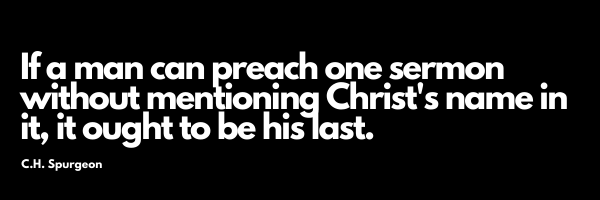
Leave Christ out? O my brethren, better leave the pulpit out altogether. If a man can preach one sermon without mentioning Christ’s name in it, it ought to be his last, certainly the last that any Christian ought to go hear him preach.

That sermon which does not lead to Christ, or of which Jesus Christ is not the top and the bottom, is the sort of sermon that will make the devils in hell to laugh, but might make the angels of God to weep.

The Spirit of God bears no witness to Christless sermons. Leave Jesus out of your preaching, and the Holy Spirit will never come upon you. Why should he? Has he not come on purpose that he may testify of Christ? Did not Jesus say, “He shall glorify me: for he shall receive of mine, and shall shew it unto you”? Yes, the subject was Christ, and nothing but Christ, and such is the teaching which the Spirit of God will own.

You do not really preach the gospel if you leave Christ out; if he be omitted, it is not the gospel. You may invite men to listen to your message, but you are only inviting them to gaze upon an empty table unless Christ is the very centre and the substance of all that you set before them.

The motto of all true servants of God must be, “We preach Christ, and him crucified.” A sermon without Christ in it is like a loaf of bread without any flour in it. No Christ in your sermon, sir? Then go home, and never preach again until you have something worth preaching.

The best way to preach sinners to Christ is to preach Christ to sinners.

Yes, it is Christ, Christ, Christ whom we have to preach; and if we leave him out, we leave out the very soul of the gospel. Christless sermons make merriment for hell. Christless preachers, Christless Sunday-school teachers, Christless class-leaders, Christless tract-distributors – what are all these doing? They are simply setting the mill to grind without putting any grist into the hopper, so all their labour is in vain. If you leave Jesus Christ out, you are simply beating the air, or going to war without any weapon with which you can smite the foe.

Of all I would wish to say this is the sum; my brethren, preach CHRIST, always and evermore. He is the whole gospel. His person, offices, and work must be our one great, all-comprehending theme. The world needs still to be told of its Saviour, and of the way to reach him.

It has been over a hundred years since Spurgeon said all of these things. Though this may lead some of us to think these are time-bound statements, they are in fact timeless statements. The chief objective of every preacher and teacher should be to preach Jesus Christ in all of his glory. He is a most rare jewel that must be looked at and pondered from every precious facet. The apostles understood this, and so did every faithful preacher and teacher throughout all of church history. We would do well to imitate them.

The Necessity of Rebuke

To rebuke somebody is to tell somebody that they have done wrong. It is, figuratively speaking, a verbal spanking (Ps. 141:5)! A godly rebuke, one that honors the Lord, is to lovingly tell somebody they have done wrong with the aim of bringing them to repentance and restoration (Gal. 6:1). An ungodly rebuke, one that dishonors the Lord, is to angrily or bitterly tell somebody they have done wrong with the aim of tearing them down. The important point is this: if either rebuke, the godly or the ungodly, is true, then it is for the benefit of the Christian.

An Illustration

Think about it this way, surgery is one of God’s ordained means to heal a person from an illness, infection, or injury that’s wreaking havoc on the body. Generally speaking, if there was no surgery, then there would be no healing. In the same way, rebuke is one of God’s ordained means to a heal a person of a spiritual malady that’s inflicting harm on the soul. So if there is no rebuke, then there will be no spiritual healing.

An Example

This truth becomes evident as one looks at the Bible. Take David for example; David was languishing in unconfessed sin after he quenched his sinful sexual passions by having intercourse with Bathsheba, another man’s wife (Ps. 32:3-4). As David languished, the Lord mercifully sent Nathan to use the scalpel of rebuke in order to expose David to the spiritual danger that he was in (2 Sam. 12:1-5). Afterwards, David confessed his sin and found restoration and forgiveness (Ps. 32:5). Nathan’s rebuke proved to bring healing. As Proverbs says, “Faithful are the wounds of a friend” (Prov. 27:6).

Rebuke…..A Despised Thing

Though what I am saying is biblically accurate, I should let you in on something. Our sin nature abhors rebuke. Since we often times desire the approval of man, we don’t like giving nor receiving rebukes, and this is understandable. Giving a rebuke is kind of like doing surgery on somebody that is not under anesthesia. You can visibly see the pain that you are causing them, so you want to stop or even avoid the surgery. And receiving a rebuke is like being under surgery without anesthesia. You feel every bit of the pain.

Despite the fact that our sin nature is repulsed by both giving and receiving rebukes, we must remember that our sin nature doesn’t desire our spiritual well-being. Our Heavenly Father desires our spiritual well-being, and those who are his children must understand God’s ordained means for rebuke in the Christian life. It is clear from the Bible that rebuke is necessary if we want to grow spiritually. And it is clear from the Bible that the godly man both gives and takes heed to rebukes, and that the ungodly man refuses to both give and listen to rebukes (Ps. 141:5; Pr. 13:1; Pr. 17:10).

How To Rebuke

So how are we supposed to rebuke people? Here’s some advice:

  1. Examine yourself to make sure you aren’t in the same sin you are about to rebuke
  2. Make sure what you are about to rebuke is actually sin, and not merely some man-made standard you have for people
  3. Make sure the sin you are about to rebuke is actually deserving of a face to face rebuke
    1. Simply put, you can’t rebuke every sin that somebody commits. I mean, you could……people just wouldn’t hangout with you anymore
  4. Be as gentle and loving as possible when you rebuke
  5. Have useful Scripture
    1. One of the purposes of the Bible is to reprove and rebuke, so let the Bible do the rebuking
  6. Expect the person you are rebuking to get defensive (this will allow you to remain calm when they actually do get defensive…….because they probably will)
  7. Do not expect the person to appreciate your rebuke immediately
    1. Often times the person will come to appreciate your rebuke hours, days, weeks, or even months later
  8. Trust God for their repentance
    1. God is the one that grants repentance, so trust him for the other person’s repentance

How to Receive Rebuke

And here is how we can receive rebuke:

  1. Be in a constant pattern of repentance
    1. This produces humility and a spirit that is willing to receive rebuke
  2. Have friends that are willing to wound you
    1. Gather godly friends around you that are willing to rebuke you when it is necessary
  3. When rebuked, in either a godly way or ungodly way, weigh the rebuke to see if there’s any truth in it
  4. If the rebuke is valid, repent as soon as possible
  5. Thank the one that rebuked you, and tell them that God used it to bring you to repentance
  6. Memorize Psalm 141:5 which says, “Let a righteous man strike me—it is a kindness; let him rebuke me—it is oil for my head; let my head not refuse it.”