

Here’s a behind-the-scenes glance at the books I’ve read since April. (I usually post an On My Shelf blog every three months, but I’ve been slacking.) I’ve added a brief book description from Amazon to give you a taste of each book. Perhaps one of these books will garner your attention and compel you to add it to your cart! But let me mention a few things before you start scrolling:
- I don’t agree with everything in every book I read
- I’ve found all of these books helpful
- I’ve found some of these books more helpful than others
- These books are listed in the order I read them
Pastor, Jesus Is Enough: Hope for the Weary, the Burned Out, and the Broken by Jeremy Writebol

In Pastor, Jesus Is Enough, Jeremy Writebol invites pastors to hear the words of the risen Jesus in the seven letters within Revelation 2–3:
- Pastors love Jesus most
- Pastors suffer
- Pastors teach and tell the truth
- Pastors become like Jesus
- Pastors abide in Jesus
- Pastors find their value in Jesus
- Pastors repent
The exhortations in Revelation 2–3 are directed to churches. But they also exhort pastors. In these letters, Jesus draws near to pastors―whether hurting or straying―and reminds them of his sufficiency. In these warnings and promises, Jesus has hard words for pastors. But they are words of life. Most of all, Jesus urges pastors to keep their focus on him. Being enough is exhausting. But pastor, the good news is that you cannot be enough. Because only Jesus is enough.
The Compelling Community: Where God’s Power Makes a Church Attractive by Mark Dever & Jamie Dunlop

What does a community that testifies to God’s power look like? God’s people are called to a togetherness and commitment that transcends all natural boundaries―whether ethnic, generational, or economic. But such a community can be enjoyed only when it relies on the power of God in the gospel.
In The Compelling Community, pastors Mark Dever and Jamie Dunlop cast a captivating vision for authentic fellowship in the local church that goes beyond small groups. Full of biblical principles and practical advice, this book will help pastors lead their congregations toward the kind of community that glorifies God, edifies his people, and attracts the lost.
America’s Religious History: Faith, Politics, and the Shaping of a Nation by Thomas Kidd

America’s Religious History is an up-to-date, narrative-based introduction to the unique role of faith in American history. Moving beyond present-day polemics to understand the challenges and nuances of our religious past, leading historian Thomas S. Kidd interweaves religious history and key events from the larger story of American history, including:
- The Great Awakening
- The American Revolution
- Slavery and the Civil War
- Civil rights and church-state controversy
- Immigration, religious diversity, and the culture wars
Useful for both classroom and personal study, America’s Religious History provides a balanced, authoritative assessment of how faith has shaped American life and politics.
Caring for One Another: 8 Ways to Cultivate Meaningful Relationships by Edward Welch

Imagine . . . an interconnected group of people who entrust themselves to each other. You can speak of your pain, and someone responds with compassion and prayer. You can speak of your joys, and someone rejoices with you. You can ask for help with sinful struggles, and someone prays with you.
The goal of this book is that these meaningful relationships will become a natural part of daily life in your church. With short chapters and discussion questions meant to be read in a group setting, Ed Welch guides small groups through eight lessons that show what it looks like when ordinary, needy people care for other ordinary, needy people in everyday life.
Are We Living in the Last Days?: Four Views of the Hope We Share about Revelation and Christ’s Return by Bryan Chapell
Will Jesus’s return be preceded by a single world government? Will every person have a government-issued ID or mark? Does Christ return once or twice? Will believers go through a Great Tribulation? Will there be a literal battle of Armageddon? Does it even matter what we believe about future events?
Biblical prophecies about the end times have confused, confounded, and even divided God’s people for centuries. But the reason Scripture gives us hints about the future is to provide the encouragement we need to endure the present, confident that God keeps his promises.
In this balanced look at four major views of the end times, bestselling author Bryan Chapell explains the primary ways Christians have interpreted biblical prophecy about the last days, not so that we might pick a hill to die on but so that we can cling to what unites us in Christ. No matter what end times view we find most compelling, in God’s plans we can find strength for today and hope for tomorrow.
Decisions Made Simple: A Quick Guide to Guidance by Tim Chester
How we get reliable guidance is always a hot topic for Christians. Should we wait for a personal ‘word’ from the Lord, perhaps delivered by some mysterious process? Does God have anything to say about the daily matters that concern his people? Can the Bible be involved in our understanding the will of God for our lives, considering that it was written when so much that is familiar to us was not dreamt of? Perhaps most importantly of all, the dangers of personal decision and guidance without considering our relationship with others, particularly the believing community, are raised. Tim Chester addresses the issues and provides clear, thoughtful biblical answers. Reflections on each section and a final decision-making checklist make this a truly practical and readable guide.
Understanding Baptism (Church Basics) by Bobby Jamison
What’s the big deal about baptism? Jesus commands his disciples to be baptized, and it’s a glorious picture of a person’s union with Jesus’ death, burial, and resurrection. Still, many Christians feel unclear about the topic, having more questions than answers. This short work provides a biblical explanation of baptism. What is it? Who should be baptized? Why is it required for church membership? And how should churches practice baptism?
Spiritual-Mindedness (Puritan Paperbacks) by John Owen
Thomas Chalmers wrote that Owen’s book on Spiritual-Mindedness holds ‘a distinguished rank among the voluminous writings of this celebrated author’. For him three features made it very special: -The force with which it applies truth to the conscience. -The way Owen plumbs the depths of Christian experience as a skillful physician of the soul. -The uncovering of the secrets of the mind and heart so that the true spiritual state of the reader is discovered. This book began life as a collection of meditations on Romans 8:6, which were written for the author’s own benefit during a time of illness. Alarmed by the subtle power the world exercises over the mind, Owen shows us how to really live by raising our thoughts above all earthly objects and setting them on ‘things above, where Christ is’ (Col. 3:1) A favorite book of William Wilberforce, it contains some passages which are not surpassed in all of Owen’s writings. It comes from the pen of a tender-hearted pastor whose only purpose is to encourage the believer in the ongoing battle against sin. So if you feel overwhelmed by the power of worldliness then this is definitely the book for you!
Undistracted: Capture Your Purpose. Rediscover Your Joy by Bob Goff
The world has never been more distracting—joy has never been more possible.
You live with a massive amount of distraction:
- desperate headlines
- smartphone scrolling
- an endless to-do list
Not to mention the nagging questions of your heart:
- Am I making the right decision?
- Am I with the right person?
- Will my past mistakes keep me from my best future?
Through the pithy and inspiring storytelling that has endeared him to millions, New York Times bestselling author Bob Goff invites you to laugh with more gusto, dream with more confidence, and love with more intention in this disarming call to live Undistracted. Bob’s stories are like the rumble strips on the road that make you suddenly alert to how far you have drifted from your lane. From visiting friends in San Quentin to accidentally getting into a stalker’s car at the airport to establishing Uganda’s first space program, Bob shows you the way back to an audaciously attentive life. Your undistracted life is an adventure waiting to happen. What stories will you live with undistracted purpose and unstoppable joy?
When Helping Hurts: How to Alleviate Poverty Without Hurting the Poor . . . and Yourself by Steve Corbett

Poverty is much more than simply a lack of material resources, and it takes much more than donations and handouts to solve it. When Helping Hurts shows how some alleviation efforts, failing to consider the complexities of poverty, have actually (and unintentionally) done more harm than good.
But it looks ahead. It encourages us to see the dignity in everyone, to empower the materially poor, and to know that we are all uniquely needy—and that God in the gospel is reconciling all things to himself.
Focusing on both North American and Majority World contexts, When Helping Hurts provides proven strategies for effective poverty alleviation, catalyzing the idea that sustainable change comes not from the outside in, but from the inside out.
Chosen by God by R.C. Sproul

Chosen by God by Dr. R. C. Sproul is a contemporary classic on predestination, a doctrine that isn’t just for Calvinists. It is a doctrine for all biblical Christians. In this updated and expanded edition of Chosen by God, Sproul shows that the doctrine of predestination doesn’t create a whimsical or spiteful picture of God, but rather paints a portrait of a loving God who provides redemption for radically corrupt humans.
We choose God because he has opened our eyes to see his beauty; we love him because he first loved us. There is mystery in God’s ways, but not contradiction.
Character Matters: Shepherding in the Fruit of the Spirit by Aaron Menikoff
Pastor, it’s time to turn down the noise and focus on what matters.

Today’s pastoral world is packed with books, conferences, and seminars teaching you different techniques for being an all-star pastor, growing your church quickly, and changing the world. But the key to true success is much harder and much simpler. Pastors are called to be faithful, to have exemplary character, and to love Jesus. Without faithfulness, their ministry ends up harming others rather than helping them. Churches need pastors with sound doctrine and a sound life.
Character Matters was written to help you slow down, cut through the noise and distractions, and focus on what matters—the fruit of the Spirit. Each chapter is a guided, biblical meditation on one aspect of each piece of the fruit of the Spirit. As you reflect and focus on the simple things that matter, you’ll see your heart change and your ministry follow, slowly, surely, and by the power of the Spirit.
Spurgeon: A Life by Alex DiPrima
“In this book, Alex DiPrima has produced what many others have failed to deliver: a one-volume biography of Spurgeon that tells the story with power, insight, and due recognition of his historical significance.”
—R. Albert Mohler Jr., president, The Southern Baptist Theological Seminary
Alex DiPrima paints a fresh portrait of Charles Haddon Spurgeon, the most well-known gospel minister of the nineteenth century. By providing social, historical, and religious context, DiPrima helps us comprehend the scope of Spurgeon’s ministry in London. Combining academic expertise with popular presentation, this short biography of the famed Prince of Preachers will be the go-to introduction to Spurgeon for years to come.
The Soul-Winning Church: Six Keys to Fostering a Genuine Evangelistic Culture by J.A. Medders
How to build a culture of truly effective gospel-sharing in your church.
Your church’s sermons often include a call to evangelize. You’ve held evangelism training events. You give out invites to your Christmas and Easter services. So… where are all the new Christians? Is your church actually reaching the lost with the gospel?
For many of us, despite having the best intentions our churches struggle to reach out with the gospel effectively. J.A. Medders and Doug Logan Jr. have decades of experience in leading churches and mentoring pastors, and here they outline six principles for cultivating a genuine evangelistic culture throughout your church.
Includes case studies from a variety of different cultures and contexts to give you practical ideas for implementing these six principles.
Shepherds for Sale: How Evangelical Leaders Traded the Truth for a Leftist Agenda by Megan Bashan
How deeply have leftist billionaires infiltrated America’s churches?

In Shepherds for Sale, Megan Basham of the Daily Wire documents how progressive powerbrokers —from George Soros, to the founder of eBay, to former members of the Obama administration— set out to change the American church. Their goal: to co-opt evangelicals for political purposes. She exposes:
The left-wing billionaires, foundations, and think tanks that deliberately target Christian media, universities, megachurches, nonprofits, and even entire denominations
- The left-wing billionaires, foundations, and think tanks that deliberately target Christian media, universities, megachurches, nonprofits, and even entire denominations
- The celebrity megachurch pastor who secretly encouraged a group of pastors to change their views on sexuality
- The revered Presbyterian theologian who backed a congregation rebelling against his own denomination
These are just a glimpse into the compromises and astroturf campaigns Basham uncovers. Many evangelical leaders are pushing their members to “whisper” about sexual sins, reconsider the importance of abortion, lament the effects of climate change, and repent of “perpetuating systemic racism.” And in exchange for toeing a left-wing line, many of those church leaders and institutions have received cash, career jumps, prestige, and praise. Basham brings the receipts, and names names.
A rigorously reported exposé, Shepherds for Sale is a warning of what happens when the church trusts the world’s wisdom instead of Scripture.
Commentaries on the Sermon on the Mount
Back in August, I began a sermon series on Matthew 5-7, The Sermon on the Mount. Here are some of the commentaries I am using:
Studies in the Sermon on the Mount by Martyn Lloyd Jones

A spiritual classic, this detailed and comprehensive study by one of the greatest expository preachers of our time explains Christ’s teaching in the Sermon on the Mount and incisively applies it to the Christian life.
With characteristic vigor and emotional vitality Dr. Lloyd-Jones presents a brilliant and detailed exposition of one of the best known but most frequently misunderstood passages of Scripture. Here is a comprehensive and exhaustive study of our Lord’s words as recorded in Matthew chapter five. This beautiful portion of the Sermon on the Mount is carefully analysed, its contents outlined and thoughtfully arranged, and vastly rich and abundant truths are gleaned for the reader’s spiritual nurture.
The author brought a wealth of devoted study as well as a profound spiritual appreciation to the work of interpreting this greatest address of our delightful experience in meditation. It presents depth of thought in simple language and beauty of style and contains a veritable thesaurus of spiritual truths drawn from the entire Bible.
Sermon On The Mount: Restoring Christ’s Message to the Modern Church by Charles Quarles

Matthew 5-7, popularly known as the Sermon on the Mount, has been described as “the essence of Christianity” and inspired many commentaries. However, New Testament professor Charles Quarles believes a fair number of those volumes either present Christ’s sermon as containing an impossible spiritual ethic or instead dilute its message so much that hardly any ethical challenge remains. Also concerning, a recent Gallup poll indicated only onethird of American adults recognize Jesus as the source of this teaching that has often inspired people who do not even embrace evangelical Christianity.
Quarles’ new analysis, part of the New American Commentary Studies in Bible & Theology series, aims to fill the gap between these extremes by dealing with the important questions of whether believers can live by the Sermon on the Mount today, and, if so, how. Looking at the Beatitudes, what it means to be salt and light, and the demand for superior righteousness, he writes to restore this crucial section of our Lord’s teaching to its proper place in His church.
The Beatitudes by Thomas Watson
The Beatitudes, written by Thomas Watson, is an exposition of Matthew 5:1-12. Thomas Watson was a prominent Nonconformist Puritan and religious author. Watson was born and raised in England and was a popular preacher until the Restoration. He is now best remembered for his many popular Christian books such as A Body of Divinity, The Godly Man’s Picture, and The Doctrine of Repentance.
The Sermon on the Mount: The Message of the Kingdom by Kent Hughes

The three chapters of Matthew known as the Sermon on the Mount contain truths so rich and powerful that even a lifetime of study could not exhaust their depths. For centuries, Jesus’s majestic portrait of the kingdom of heaven and his unparalleled instructions for godliness have captivated Christians and non-Christians alike. In this classic commentary, now revised with a fresh look and ESV Bible references, seasoned pastor R. Kent Hughes guides readers through this glorious portion of the Bible with exegetical precision, expositional clarity, and practical sensitivity. Whether used by preachers, small group leaders, or individual laypersons, this resource will prove invaluable for illuminating the Sermon on the Mount’s enduring power to enliven hearts and transform minds.
Matthew 1-7 by John MacArthur
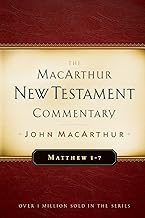
The Old Testament looked forward to the final King of kings who would bring everlasting salvation and peace. In his Gospel, Matthew demonstrates that Jesus Christ is that King, perfect in His eternal glory and majesty. As the King’s ambassadors, Christians today will find in Matthew great motivation for heartfelt worship and service.
Join John MacArthur as he explains each verse of Matthew 1–7 in a way that is both doctrinally precise and intensely practical. Taking into account the cultural, theological, and Old Testament contexts of each passage, MacArthur tackles interpretive challenges and fairly evaluates differing views, giving the reader confidence in his conclusions.
The MacArthur New Testament Commentary series comes from the experience, wisdom, and insight of one of the most trusted ministry leaders and Bible scholars of our day. Each volume was written to be as comprehensive and accurate as possible, dealing thoroughly with every key phrase and word in the Scripture without being unnecessarily technical. This commentary will help to give a better, fuller, richer understanding of God’s Word, while challenging the reader to a vibrant personal spiritual walk.
Sermons on the Beatitudes
I began my sermon series on the Sermon on the Mount with a mini-series on the Beatitudes. I have attached links to the audio recordings of each sermon.
Blessed are the Spritual Beggars

 Doctrine & Devotion