
There are different ministry philosophies out there. You may be ignorant of their names, but you have seen them in practice. Though all of them have their dangers, they are not equal. That said, I will start with the best and healthiest philosophy of ministry and end with the absolute worst.
The “Theocentric and Bibliocentric” Philosophy of Ministry
According to this ministry philosophy, pastors make decisions primarily in accordance with the glory of God and fidelity to Scripture. What’s the danger? There aren’t many, but let me list one. At times, pastors can lose sight of the sheep—especially individual sheep—as they seek to transform the ministries of the church to conform to clear biblical teaching. In other words, pastors can make the right moves in harsh or rigid ways that hurt the very sheep they are trying to help.
The “Missional” Philosophy of Ministry
Here, pastors make decisions primarily in hopes of taking the gospel to the community, the state, and the world. What’s the danger? According to Scripture, pastors and the ministries of the church ought to focus on the building up of the church and the salvation of the lost. So here’s the danger: it does not take much for pastors who have embraced a “Missional” philosophy of ministry to lose sight of the edification of the church while attempting the evangelization of the world. The result is an army of spiritually immature and biblically illiterate Christians seeking to evangelize a dark world that is ignorant of the things of God.
The “Traditional” Philosophy of Ministry
In this model, pastors make decisions primarily in accordance with the local church’s history and traditions. What’s the danger of this philosophy? In an effort to adhere to tradition, pastors may lead the church to violate or overlook the clear teaching of Scripture.
The “Programmatic” Philosophy of Ministry
This ministry philosophy seeks to build a healthy church by creating lots and lots of programs, such as children’s church, children’s choir, Fifth Sunday singings, AWANA, revivals, and community groups. This has several dangers:
- It’s possible to implement “successful” programs that are at odds with God’s Word.
- The desire to sustain programs can lead to placing unqualified people in leadership.
- Faithful, devoted members can become exhausted, not by ministry, but by ceaseless activity. In the end, the church becomes busy without being healthy.
The “Seeker-Sensitive” Philosophy of Ministry
Here, pastors shape decisions around attracting and winning unbelievers. What’s the danger? It’s really twofold: first, pastors and church ministries can become so hyper-focused on “winning” unbelievers that they end up neglecting the sheep. Second, “winning” unbelievers often gives way to merely entertaining unbelievers, which can cause pastors and church ministries to drift away from biblical teaching and practice. In other words, those who’ve embraced the “Seeker-Sensitive” model usually end up seeking to win the world by becoming like the world.
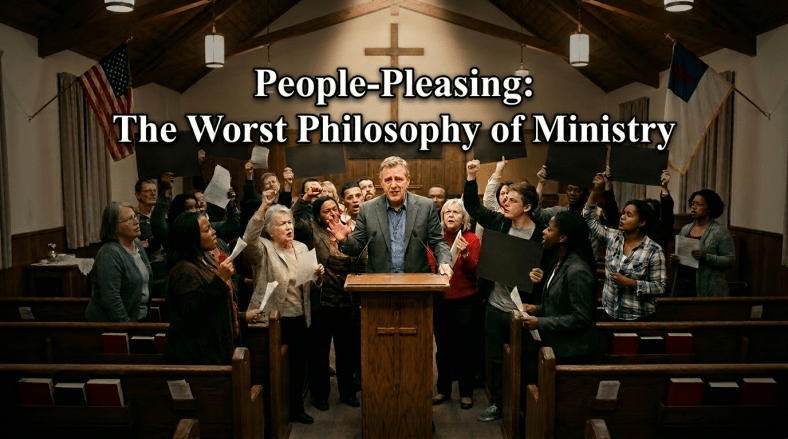
The “People-Pleasing” Philosophy of Ministry
In this model, pastors make decisions primarily to appease people—often the loudest, most dissatisfied people in the room. My momma would call it the “Squeakiest Wheel Gets the Most Grease” philosophy of ministry. The dangers are legion:
- The fear of God no longer governs decision-making; the fear of man does.
- Scripture no longer guides the church; the shifting winds of human opinion do.
- Prudence no longer filters what the pastor says; nods of affirmation do.
- Godly wisdom no longer determines which ministries are offered; personal preferences do.
- Chapters and verses no longer shape what is preached; “atta-boys” do.
- The role of the pastor shifts from shepherd to appeaser.
- The spiritually immature become entitled, increasingly expecting the church to revolve around their preferences.
- The spiritually immature grow louder, realizing that complaining is the fast track to getting their way.
- The spiritually mature become discouraged, increasingly frustrated that biblical truth is compromised to satisfy complaints.
- Church discipline is neglected, allowing sin, division, and disorder to spread.
- The church drifts from being Christ-centered to being people-centered.
And let me say this plainly: of all the ministry philosophies out there, the philosophy of people-pleasing is the worst. When pastors adopt a people-pleasing philosophy, they abdicate their God-given responsibility to lead, guide, and protect the church, handing that responsibility over to the most immature and discontent members of the flock.
 Doctrine & Devotion